
Web Hosting Cost for a Small Business: 7 Real Truths (2026)
The advertised price is almost never what you’ll pay. Here’s what a real small-business website actually costs to host in 2026 — across year 1, year 3, and every hidden line item in between.
The web hosting cost for a small business in 2026 sits somewhere between “absurdly cheap” and “genuinely expensive” — and the truth is, most owners overpay by 40–70% without realizing it. Not because hosting is complicated, but because almost every provider prices the first year far below what years two and three actually cost.
This guide breaks down the real web hosting cost for a small business across shared, VPS, and managed tiers — using current 2026 pricing from eight major providers. You’ll see the full year-3 total cost, the hidden fees most beginners miss, and the one metric that separates a good deal from a trap: the intro-to-renewal gap.
For most small businesses in 2026, the realistic 3-year web hosting costs are $150 – $600 on shared hosting, $500 – $1,800 on VPS, and $1,000 – $3,500 on managed hosting — after you add backups, SSL, domain, and the renewal hike.
01. How Much Does Web Hosting Actually Cost in 2026?
The short answer: shared hosting ranges from $2 to $15 per month, VPS hosting from $5 to $40 per month, and managed hosting from $15 to $100+ per month in 2026. Shopify’s 2026 analysis places typical shared hosting at $5–$20/month and VPS at $20–$40/month, which aligns with what we’re seeing across major providers.
But those ranges hide the real story. The web hosting cost for a small business is almost never the advertised monthly rate. It’s the rate after the intro period expires, after you add backups and SSL, after you pay for domain privacy, and after you discover that “free migration” sometimes costs $149.
The three hosting tiers, in plain English
You share a server with hundreds of other sites. Cheapest option. Fine for brochure sites, blogs, and stores under 10,000 monthly visits.
Your own slice of a server with guaranteed resources. Much faster. Right for growing businesses with 10k–100k monthly visits.
Someone else handles updates, security, and backups. Most expensive. Best if you don’t want to touch a server ever.
The decision isn’t really about features anymore — most providers offer similar tech. It’s about whether the real 3-year web hosting cost for a small business matches what the salesperson quoted you on day one.
02. The Intro-to-Renewal Price Gap: The #1 Gotcha
This is the single biggest mistake beginners make when calculating the web hosting cost for a small business. Providers advertise an “introductory” price that applies only to your first billing term (usually 36 or 48 months prepaid). Once that term ends, the plan renews at a rate that’s often 3–9 times higher.
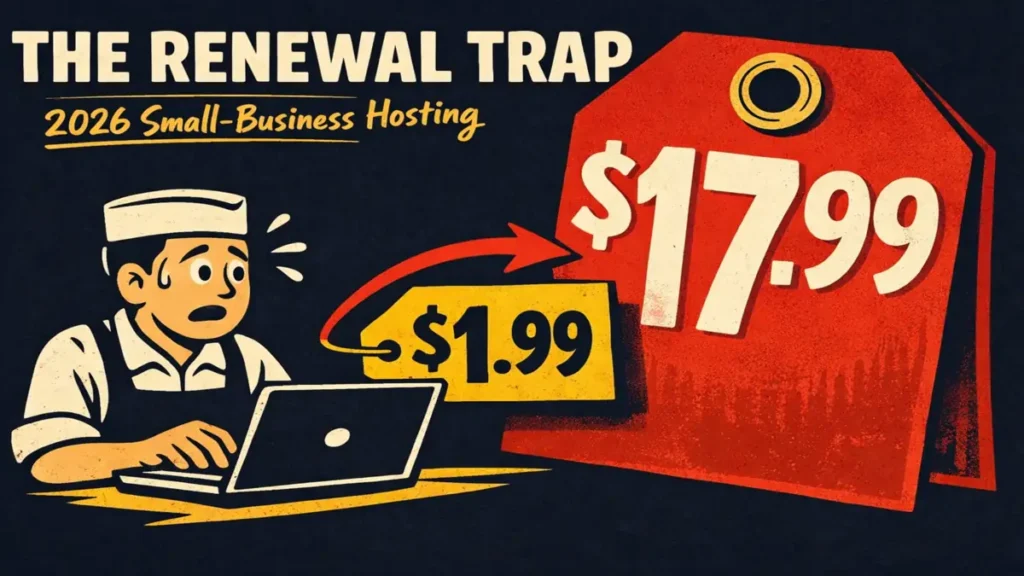
According to AllAboutCookies’ 2026 analysis, SiteGround’s cheapest plan jumps from $1.99/month to $17.99/month on renewal — a 9× increase. Bluehost goes from $1.99 to $8.99 (4.5×). Hostinger climbs from $2.99 to $10.99 (3.7×). Even IONOS’s ultra-cheap $1/month entry plan renews at $16/month.
Why providers do this
The math is simple: most customers never leave. Once your site, emails, and databases live on a provider’s server, the friction of moving is high enough that the provider can raise prices and keep you. The web hosting cost for a small business is built around this assumption. You’re quoted a price for year one and gently trained to ignore year three.
Auto-renewal is on by default at almost every host. If you ignore it, your $1.99/month shared plan will become $17.99/month on the day your term ends — charged to your card automatically.
03. Year-1 vs Year-3 Total Cost of Ownership
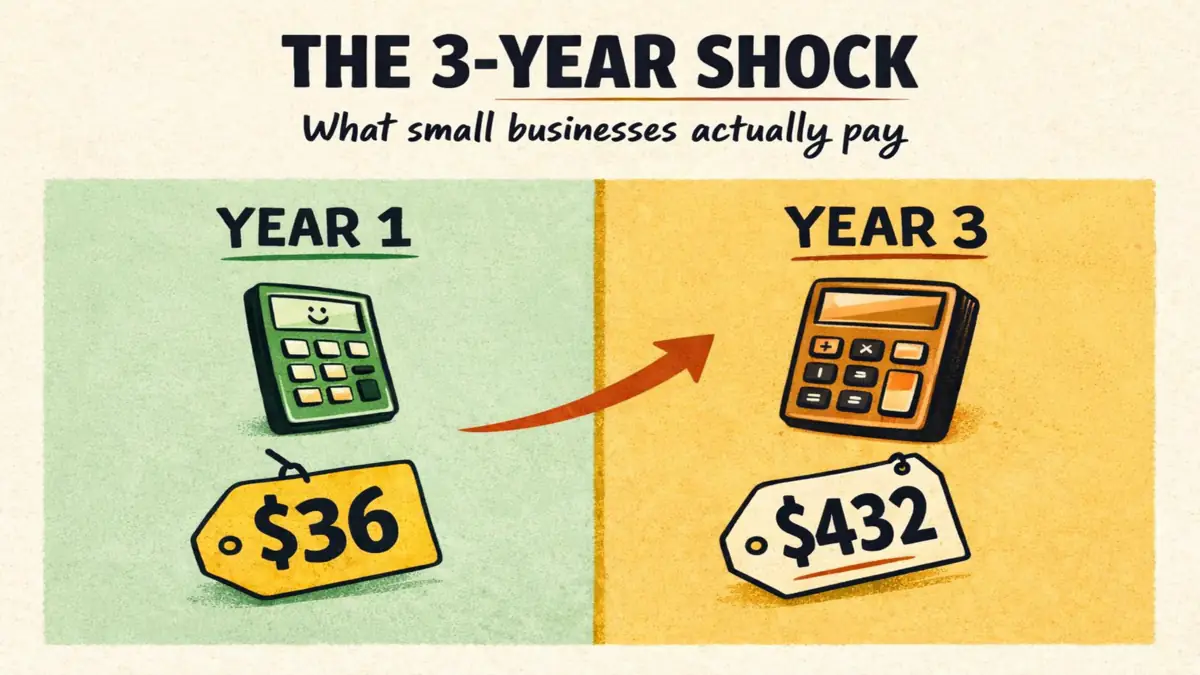
Here’s what the realistic web hosting cost for a small business looks like over three years, broken down by tier. These totals include the typical renewal jump, a .com domain after year one, and basic SSL, where it isn’t free.
Shared hosting — 3-year total
| Cost Line | Year 1 (intro) | Year 2 (renewal) | Year 3 (renewal) | 3-Yr Total |
|---|---|---|---|---|
| Hosting plan | $36 | $132 | $132 | $300 |
| .com domain | Free | $15 | $15 | $30 |
| Domain privacy | $12 | $15 | $15 | $42 |
| Automated backups | $36 | $36 | $36 | $108 |
| Realistic 3-year shared total | $480 | |||
VPS hosting — 3-year total
| Cost Line | Year 1 | Year 2 | Year 3 | 3-Yr Total |
|---|---|---|---|---|
| Managed VPS plan | $180 | $360 | $360 | $900 |
| Domain + privacy | $12 | $30 | $30 | $72 |
| Offsite backups | $60 | $60 | $60 | $180 |
| Realistic 3-year VPS total | $1,152 | |||
A fair 3-year web hosting cost for a small business on shared is about $480 all-in. On VPS, it’s around $1,152. On managed hosting the equivalent total often runs $2,000–$3,500 once all extras are counted.
04. 2026 Provider Comparison — Intro vs Renewal
This is the table most small-business owners actually need. Eight major providers, their real 2026 intro and renewal pricing on entry-level plans, and the multiplier that shows you how aggressive the price hike is.
| Provider | Tier | Intro Price | Renewal Price | Multiplier |
|---|---|---|---|---|
| Hostinger | Shared | $2.99/mo | $10.99/mo | 3.7× |
| Bluehost | Shared | $1.99/mo | $8.99/mo | 4.5× |
| SiteGround | Shared | $1.99/mo | $17.99/mo | 9.0× |
| IONOS | Shared | $1.00/mo | $16.00/mo | 16.0× |
| Hostinger VPS | VPS | $6.49/mo | $16.99/mo | 2.6× |
| DreamHost VPS | VPS | $10.00/mo | $15.00/mo | 1.5× |
| ScalaHosting | Managed VPS | $14.95/mo | $29.95/mo | 2.0× |
| DigitalOcean | Unmanaged VPS | $4.00/mo | $4.00/mo | 1.0× |
The lower the multiplier, the more transparent the pricing. DigitalOcean (1.0×) and DreamHost (1.5×) are the only providers here that don’t punish you for staying. SiteGround’s 9.0× and IONOS’s 16.0× are the two to budget around most carefully.
05. The Hidden Fees Most Small Businesses Miss
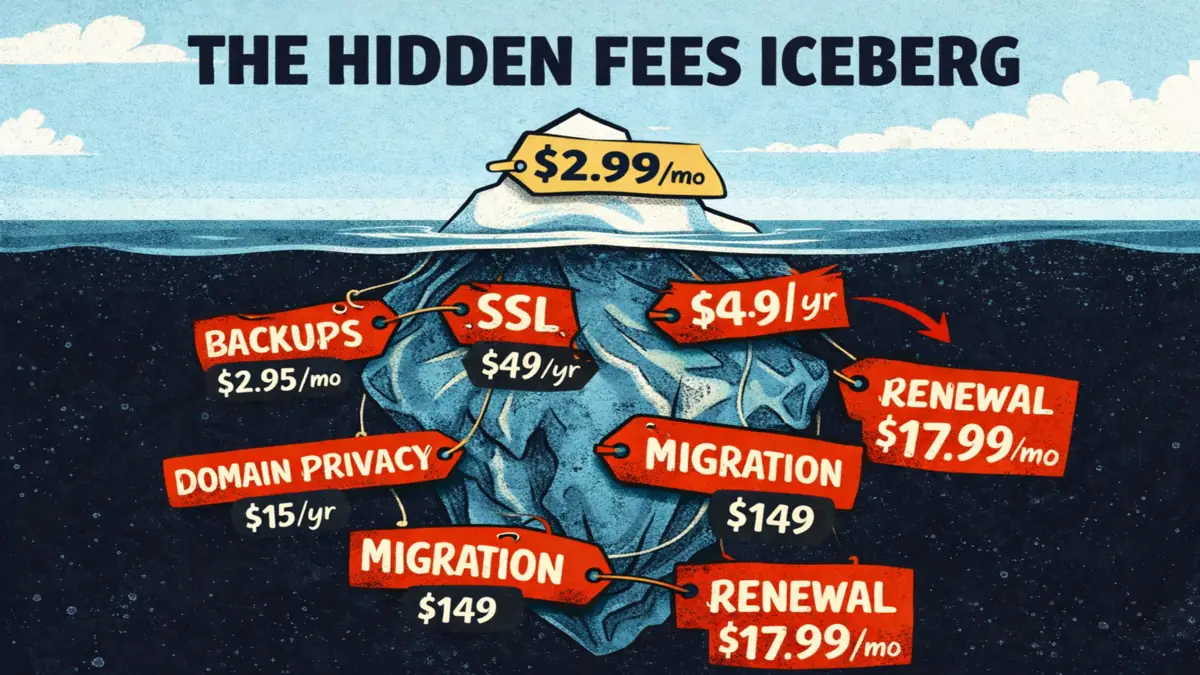
Advertised hosting prices are the tip of the iceberg. The real web hosting cost for a small business only becomes visible at checkout and at renewal, when a dozen small “add-ons” quietly appear on your invoice.
The six hidden costs to expect
$2–$5/month on most cheap hosts. Sometimes free but only kept 7 days, which is useless if a hack goes unnoticed for a month.
Free on most reputable hosts in 2026, but a few budget providers still charge $49–$99/year. Non-negotiable for a business site.
$12–$15/year to hide your home address from public WHOIS. Bluehost charges $11.88 in year one, then $15 every year after.
Advertised as “free” but often conditional. Some hosts charge $149 per site if you have custom configurations or more than one site.
Bluehost charges $2.99/mo per mailbox after a free trial. A five-person team pays $180/year just for email.
Hostinger adds 20% VAT at checkout. A $191 advertised plan becomes $229 when you actually pay. Budget accordingly.
Added together, these six items typically inflate the advertised web hosting cost for a small business by $200–$500 per year. That’s the gap between the price on the sales page and the amount that actually leaves your bank account.
06. Which Tier Does a Small Business Actually Need?
Most small-business websites are drastically oversold on hosting. You don’t need a $40/month VPS to host a 12-page plumber site that gets 800 visits a month. But you also shouldn’t run a 50-product WooCommerce store on a $2.99 shared plan with noisy neighbors.
A simple decision framework
Brochure sites, local businesses, blogs, and simple WordPress sites. Shared hosting from Hostinger or Bluehost is genuinely enough. Budget $480 over 3 years including domain and backups.
Small WooCommerce stores, membership sites, and busier blogs. Managed VPS gives you predictable performance without requiring server skills. Budget $1,200 over 3 years.
Stores and sites where downtime directly costs money. Managed WordPress or managed cloud hosting. Budget $2,000–$3,500 over 3 years, but you save time on maintenance.
07. Seven Ways to Cut Your Real Hosting Cost
If you already understand the intro-renewal trap, you can reduce the web hosting cost for a small business by 30–60% without sacrificing quality. These are the tactics that actually work in 2026.
- Commit to the longest term you can afford. 48 months locks in the lowest intro rate. Bluehost’s Starter plan costs $3.99/mo on a 36-month plan and $4.99/mo on a 12-month plan.
- Turn off auto-renewal on day one. Then set a calendar reminder 30 days before the term ends so the renewal price never surprises you.
- When the term expires, migrate rather than renew. Most hosts offer free migration for new customers. A migration every 3–4 years keeps you on intro pricing indefinitely.
- Only buy the add-ons you actually need. Skip SEO tools, SiteLock, and “priority support” upsells. You can add them later if needed.
- Buy your domain separately. A Cloudflare or Namecheap domain at $10/year beats the $15–$20/year renewal at most hosts.
- Use free Cloudflare for SSL and CDN. Cuts both your SSL line item and your bandwidth costs to zero.
- Choose hosts with low renewal multipliers. DreamHost (1.5×), DigitalOcean (1.0×), and ScalaHosting (2.0×) are much kinder in the long term than the 9× and 16× jumpers.
08. Google’s 2026 View on Hosting Quality
Hosting is no longer a neutral technical decision. Google’s Core Web Vitals directly measure how fast your server responds, and slow hosting now hurts your rankings as much as thin content does. The cheapest plans often score poorly on Time to First Byte because they over-crowd servers.
If your server responds in under 200ms and Largest Contentful Paint stays under 2.5 seconds, Google treats your hosting as “good,” which is achievable even on $5/month plans if the host isn’t oversold.
The practical takeaway: the cheapest web hosting for a small business isn’t necessarily the best value for SEO. Pay a few dollars more per month to avoid the $1-level oversold shared plans. Your rankings will thank you.
Bonuses & Resources
| Resource | What It Does | Link |
|---|---|---|
| Free Keyword Research Tool | Check the search volume for any hosting-related keyword before you commit to content. | Open tool → |
| Backlink Value Calculator | Estimate the long-term SEO value of one backlink to your hosted site. | Open tool → |
| Google PageSpeed Insights | Test whether your current hosting meets Google’s Core Web Vitals thresholds. | pagespeed.web.dev → |
Further Reading
- AI Tech News December 2025 — our pillar post
- How Much Do Backlinks Really Cost in 2026?
- Free SEO Tools — Keyword, Backlink & More
- Shopify — Web Hosting Cost 2026 Overview
- Hostinger — Website Hosting Cost Tutorial 2026
ScalaHosting — Managed Cloud VPS from $14.95/mo
Unlimited websites, free migration, daily backups, free SSL, SPanel included, and a 2× renewal multiplier instead of 9×. One of the few managed VPS providers that doesn’t punish loyal customers.
Keyword research, backlink value calculators, SEO checkers — free, no signup, built for small businesses.
Frequently Asked Questions
Q: What is the realistic web hosting cost for a small business in 2026?
A: For most small businesses, the realistic 3-year web hosting cost for a small business is $150–$600 on shared hosting, $500–$1,800 on VPS, and $1,000–$3,500 on managed hosting — once you include the renewal hike, domain renewal, backups, and SSL.
Q: Why is the renewal price so much higher than the intro price?
A: Hosts use deeply discounted intro rates to acquire customers. Once your website, emails, and databases are hosted on their server, the cost of switching is high enough that most customers stay — so the provider raises prices, often by 3×–9×, and keeps the revenue.
Q: Which hosting type is best for a new small business?
A: Shared hosting is right for 80% of new small businesses with under 10,000 monthly visits. Move up to VPS only when you outgrow shared resources or when downtime starts costing you actual revenue.
Q: Are free web hosting plans good enough for a small business?
A: No. Free hosting typically includes ads on your site, no custom domain, no SSL, and no backup guarantees — all of which actively erode customer trust and hurt Google rankings. Budget at least $3/month.
Q: What hidden fees should I watch for on my hosting invoice?
A: Six items to budget for: automated backups ($2–$5/month), SSL on cheap hosts ($49–$99/year), domain privacy ($12–$15/year), migration fees ($0–$149), email hosting ($2.99/mailbox/month on some hosts), and VAT or sales tax at checkout.
Q: Should I prepay for a 48-month term to lock in the intro price?
A: Only if you are confident in the provider and you’ve turned off auto-renewal. Prepaying lowers your monthly rate significantly, but you lose flexibility if the host underperforms. For first-time buyers, 12–24 months is a safer compromise.
Q: Does hosting quality actually affect my Google rankings?
A: Yes. Google’s Core Web Vitals measure server response time directly. A slow Time to First Byte on oversold, cheap hosting can drop you several positions on competitive keywords. Aim for server response under 200ms.
Q: How do I avoid paying the renewal price trap forever?
A: Two options. First, pick a provider with a low renewal multiplier from day one — DreamHost, DigitalOcean, or ScalaHosting all keep renewal prices close to the intro price. Second, plan to migrate to a new host every 3–4 years using free migration services, which resets you onto intro pricing.
The web hosting cost for a small business in 2026 is not the advertised monthly rate. It’s the 3-year total, including renewals, backups, SSL, and domain privacy. For most small businesses, that number lands around $480 on shared hosting and $1,152 on managed VPS — a lot less than panic headlines suggest, but a lot more than the $1.99/month banners promise.
Pick a host with a low renewal multiplier, turn off auto-renewal, and budget for the hidden fees before you commit. If you want a shortcut, managed cloud VPS from ScalaHosting gives you predictable pricing, unlimited sites, and free migration without the 9× renewal surprise.
|
HR
|
Hans Rostek
Founder of AI Key for Riches. Writes about AI tools, SEO, and affiliate marketing for small-business owners who want honest pricing and practical workflows. Published April 2026.
|
© 2026 AI Key for Riches · ai.keyforriches.com · All rights reserved.