


ScalaHosting Series — Article #5 of 20
OpenLiteSpeed vs LiteSpeed Enterprise ScalaHosting:
7 Proven Differences That Decide Your VPS Setup
Confused by the OpenLiteSpeed vs LiteSpeed Enterprise ScalaHosting choice when signing up for a VPS? You are not alone. This guide breaks down every meaningful difference across 7 proven criteria — performance, caching, Apache compatibility, pricing, and real-world use cases — so you can make the right call before spending a cent on an upgrade.
📅 Updated April 2026
⏱️ 13 min read
📌 Article #5 of 20
01 OpenLiteSpeed vs LiteSpeed Enterprise ScalaHosting — Why This Question Trips Up Every New VPS Buyer
The OpenLiteSpeed vs LiteSpeed Enterprise ScalaHosting question hits you at the worst possible moment: right on the checkout page, when you are already committed to a VPS plan and suddenly see an option to add “LiteSpeed Web Server” for an extra monthly fee. Should you pay for it? Is the free version already included enough? What exactly is the difference?
This guide exists because no dedicated comparison answers this question specifically for ScalaHosting users. The answer is scattered across ScalaHosting’s knowledge base, LiteSpeed’s own documentation, and half a dozen hosting forums — and most of those sources have an agenda. Here, you get the clear, buyer-perspective answer based on real use cases.
First, the baseline facts every new ScalaHosting customer needs to know about OpenLiteSpeed vs LiteSpeed Enterprise ScalaHosting:
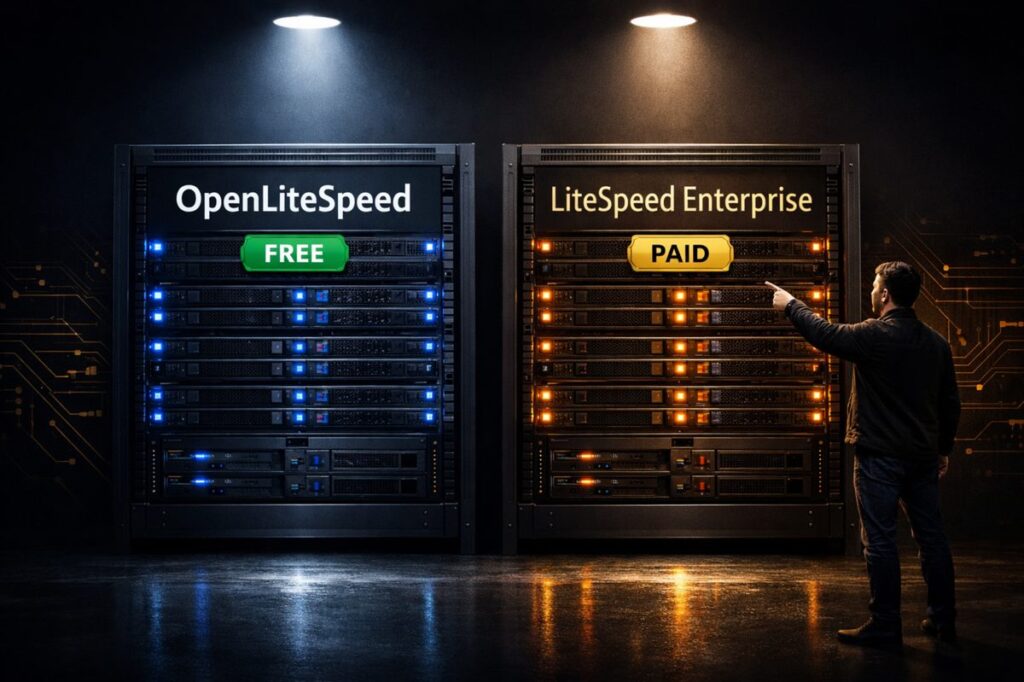
- OpenLiteSpeed (OLS) — the free, open-source edition. Included at no extra cost on all ScalaHosting managed Cloud VPS plans from Day 1. Handles WordPress, PHP, static files, and HTTP/3 out of the box.
- LiteSpeed Enterprise (LSWS) — the commercial edition, developed by LiteSpeed Technologies. Available on ScalaHosting as a paid add-on. Adds advanced caching, full Apache drop-in replacement, and a commercial LSCache implementation.
Both are built by the same company — LiteSpeed Technologies. They share the same core engine and support for HTTP/3 and QUIC. The openlitespeed vs litespeed enterprise scalahosting decision is therefore not about choosing between fast and slow — it is about whether the specific Enterprise features justify the cost for your workload.
For the vast majority of WordPress bloggers, small business sites, and growing content sites on ScalaHosting VPS plans, OpenLiteSpeed is entirely sufficient. LiteSpeed Enterprise becomes worth the upgrade cost only in specific high-traffic or legacy Apache scenarios covered in Section 06.
02 OpenLiteSpeed vs LiteSpeed Enterprise ScalaHosting — What Each Version Actually Is
Before the 7 proven differences, it is essential to understand the shared ancestry of both servers in the OpenLiteSpeed vs. LiteSpeed Enterprise Scalahosting comparison. Both are products of LiteSpeed Technologies, a US company founded in 2002. The key split happened when LiteSpeed open-sourced a stripped-down version of its commercial server under the OpenLiteSpeed brand in 2013.
What OpenLiteSpeed Is
OpenLiteSpeed is a fully open-source, event-driven web server built for high concurrency with low resource overhead. It supports HTTP/1.1, HTTP/2, HTTP/3, and QUIC natively. For WordPress sites, it works with the free LiteSpeed Cache (LSCache) plugin, one of the highest-rated caching plugins on the market, with over 6 million active installs. OLS is actively maintained, receives regular security patches, and is used by millions of production websites globally.
What LiteSpeed Enterprise Is
LiteSpeed Enterprise (LSWS) is the full commercial product. It is a true Apache drop-in replacement — it reads Apache configuration files (.htaccess) directly without rewriting them, making it the choice for applications and control panels that depend on Apache-style configuration. It includes the full commercial LSCache implementation, enhanced server-side caching APIs, ESI (Edge Side Includes) support, and priority technical support directly from LiteSpeed Technologies. On ScalaHosting, it is available as a paid add-on to any managed Cloud VPS plan.
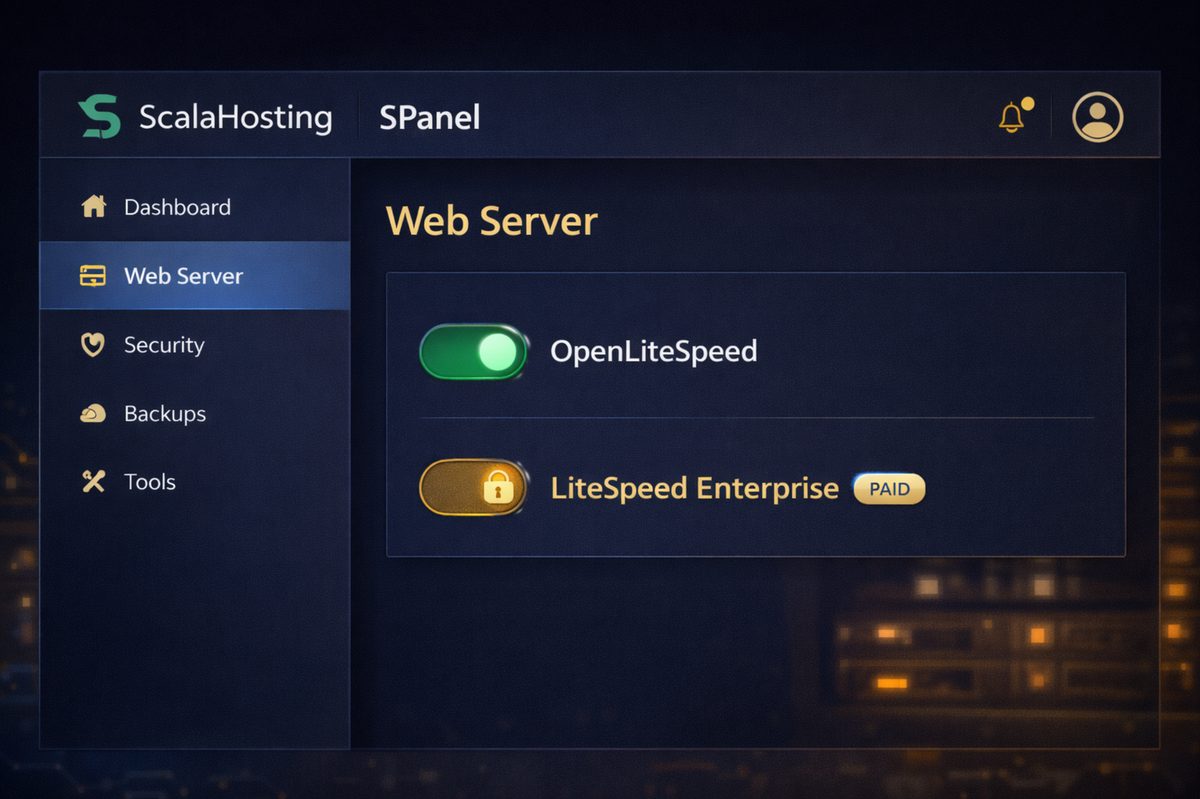
When ScalaHosting shows “LiteSpeed Web Server” as an add-on option, it refers to LiteSpeed Enterprise. Your plan already includes OpenLiteSpeed for free. The upsell is for the commercial upgrade — not the baseline server. Most buyers do not need the upgrade. Read Section 06 before paying for it.
03 Difference 1 & 2 — Performance and Caching: Is LiteSpeed Enterprise Actually Faster?
The first two of the 7 proven differences in the OpenLiteSpeed vs LiteSpeed Enterprise ScalaHosting comparison address the question buyers care about most: does Enterprise make your site load faster, and is the caching system meaningfully better?
Difference 1 — Raw Performance
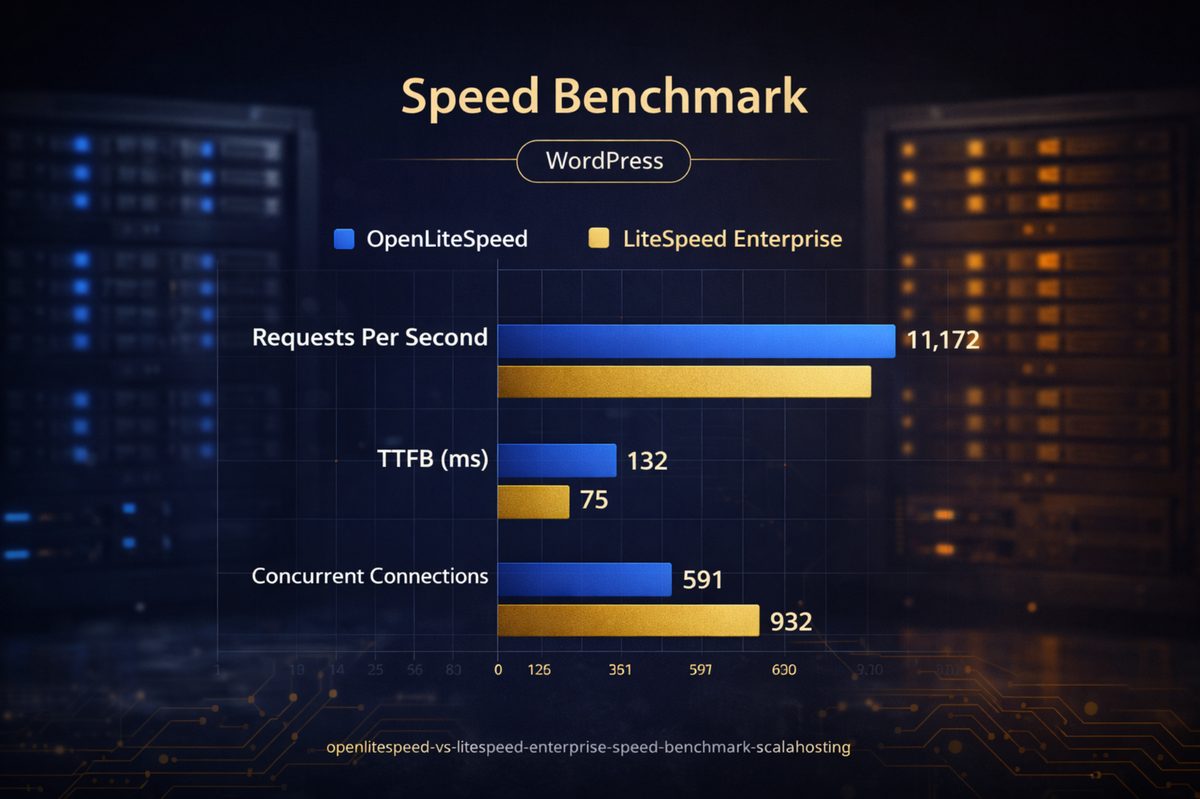
Both OLS and LSWS share the same core event-driven architecture and HTTP/3 engine. In independent benchmarks from LiteSpeed Technologies and third-party testing by InMotion Hosting, the performance delta between OpenLiteSpeed and LiteSpeed Enterprise on equivalent hardware is negligible for typical web workloads — often less than 2–5% in requests per second. The difference becomes more pronounced only at extreme concurrency levels (thousands of simultaneous connections) that are beyond the traffic volume of most VPS-hosted websites.
On ScalaHosting’s hardware specifically — AMD EPYC 9474F CPUs, DDR5 RAM, and PCIe 5.0 NVMe SSDs — OpenLiteSpeed already delivers sub-50ms global TTFB via FlyingCDN and an average page load time of 1.7 seconds (HostingCritic). Those numbers are a hardware-and-infrastructure story as much as a web server story. Upgrading to LiteSpeed Enterprise on the same hardware produces no dramatic change in that baseline performance profile for most site types.
Difference 2 — Caching Architecture
This is where a genuine and meaningful difference exists. OpenLiteSpeed uses the LiteSpeed Cache WordPress plugin (free, 6M+ installs) with server-level cache stored on disk. It is powerful and covers full-page caching, object caching, browser caching, image optimization, and lazy loading. For the overwhelming majority of WordPress sites, this free LSCache implementation is outstanding and fully sufficient.
LiteSpeed Enterprise adds: ESI (Edge Side Includes) — enabling selective per-block cache invalidation rather than full-page cache purging, which matters for membership sites, WooCommerce stores, and pages with personalized dynamic content. It also provides full server-side cache API access, advanced HTTP/2 Push for complex resource prioritization, and priority queue placement for cache operations under high concurrency. For a WooCommerce store processing 500+ simultaneous sessions, these extras are meaningful. For a 10,000-visitor-per-month blog, they are invisible.
04 Difference 3 & 4 — Apache Compatibility and .htaccess Support
Differences 3 and 4 in the openlitespeed vs litespeed enterprise scalahosting comparison are the most technically significant for buyers migrating from Apache-based hosting environments.
Difference 3 — Apache Drop-In Replacement
This is the clearest Enterprise-only advantage. LiteSpeed Enterprise is a certified Apache drop-in replacement. It reads Apache httpd.conf and VirtualHost configuration files natively — no conversion, no rewriting. This means a server that was running Apache can switch to LiteSpeed Enterprise at the OS level, and every application, control panel, and site on that server continues to work without any configuration changes.
OpenLiteSpeed is not an Apache drop-in replacement. It has its own configuration syntax. Migrating a complex Apache-configured server to OLS requires manual configuration translation — a real workload for server administrators managing multiple applications or complex rewrite rules. For a standard WordPress site on a fresh ScalaHosting VPS, this difference is irrelevant. For someone migrating a server that ran 40 Apache VirtualHosts with custom rewrite rules, it is critical.
Difference 4 — .htaccess Processing
LiteSpeed Enterprise reads and processes .htaccess files natively and in real time, exactly as Apache does. Every Apache rewrite rule, access control directive, and mod_rewrite instruction works without modification. OpenLiteSpeed has partial .htaccess support — it handles the most common directives (WordPress permalink rewrites, basic redirects) correctly, but complex or non-standard Apache directives are either unsupported or require manual conversion to OLS configuration syntax.
In practice: if your site uses only standard WordPress .htaccess rules (which 99% of WordPress sites do), OpenLiteSpeed handles them perfectly. If you are running legacy PHP applications, complex multi-domain setups, or applications that write to .htaccess dynamically (some membership plugins, URL shorteners, or old-school PHP apps), LiteSpeed Enterprise is the safer choice on openlitespeed vs litespeed enterprise scalahosting.
Agencies migrating multiple client sites from Apache hosting. Developers running applications with complex Apache module dependencies. Server admins managing cPanel/WHM stacks (though SPanel uses its own configuration). Anyone moving from a traditional shared hosting environment where .htaccess controls routing for non-WordPress applications.
Fresh WordPress installs on ScalaHosting VPS. Bloggers, affiliate marketers, content site owners, and small business websites are using standard WordPress themes and plugins. N8N self-hosted users (like this author). Any site launched directly on SPanel that has never run on Apache.
05 Difference 5 — Admin Panel & Configuration: OLS WebAdmin vs Enterprise Admin
The fifth difference in openlitespeed vs litespeed enterprise scalahosting is the management interface and configuration workflow, which has a real day-to-day impact on how you manage your server.
OpenLiteSpeed ships with WebAdmin GUI — a browser-based configuration panel accessible at port 7080. From WebAdmin, you can configure virtual hosts, listeners, rewrite rules, SSL certificates, and PHP handlers. It is functional and sufficient for most server management tasks. However, WebAdmin is separate from SPanel — meaning you manage some settings via SPanel and others via the OLS WebAdmin. For beginners, this two-panel setup can cause confusion.
LiteSpeed Enterprise integrates more cleanly with SPanel because it follows the Apache-style configuration that SPanel’s underlying tooling expects. The Enterprise admin interface is also more mature, with a cleaner UI and more direct integration with commercial support channels. ScalaHosting’s managed service layer handles most low-level configuration on your behalf, regardless of which edition you choose — so for typical managed VPS users, this difference is largely abstracted away by ScalaHosting’s own management tooling.
On ScalaHosting’s managed plans, you rarely need to interact directly with the web server’s admin panel at all. ScalaHosting’s support team handles server-level configuration. You manage websites through SPanel. The OLS WebAdmin vs LSWS Admin difference matters primarily to system administrators who self-manage their server configuration. If you are on a managed plan and rely on 30-second live chat support, this distinction is largely invisible in day-to-day use.
06 Differences 6 & 7 — Cost, Support, and the Exact Buyer Decision Framework
The sixth and seventh differences in OpenLiteSpeed vs. LiteSpeed Enterprise Scalahosting come down to money and support — and the decision framework every ScalaHosting buyer should apply before opening their wallet.
Difference 6 — Cost: The Real Monthly Impact
OpenLiteSpeed incurs no extra cost on any ScalaHosting-managed Cloud VPS plan. LiteSpeed Enterprise is available as a paid add-on — approximately $19.95–$24.95/month depending on the plan tier (verify current pricing on your ScalaHosting dashboard as rates may vary). Over a year, that is an additional $240–$300 in spending. Over three years, it is $720–$900. That money buys a meaningful VPS upgrade — more RAM, more CPU, more storage — which will benefit your site’s performance far more visibly than the marginal server-side gains from Enterprise over OpenLiteSpeed for most workloads.
Difference 7 — Support Tier and Commercial Licensing
OpenLiteSpeed is open-source — support is community-based (forums, GitHub issues, ScalaHosting’s own support team). LiteSpeed Enterprise includes direct commercial support from LiteSpeed Technologies, along with priority bug-fix SLAs and guaranteed patch timelines for enterprise security vulnerabilities. For mission-critical production environments — payment processing sites, healthcare portals, enterprise SaaS applications — this commercial support tier has tangible value. For content sites, blogs, and standard WooCommerce stores, ScalaHosting’s 24/7 live chat with a 30-second response time is more than adequate support coverage, regardless of which edition you run.
You run standard WordPress sites. Your traffic is under ~100,000 visits/month. You have no legacy Apache configuration files. You installed WordPress fresh on ScalaHosting via SWordPress Manager. You are a blogger, affiliate marketer, SME, or growing content business.
You are migrating from Apache and have a complex .htaccess or VirtualHost configuration. You run WooCommerce at 100,000+ monthly sessions with dynamic per-user cart pages. You need ESI for personalized/membership content cache. You require commercial LiteSpeed support SLAs for a mission-critical application. You run a hosting agency managing 20+ client accounts with diverse application stacks.
07 OpenLiteSpeed vs LiteSpeed Enterprise ScalaHosting — Full Side-by-Side Comparison Table
Here is the complete 7-difference OpenLiteSpeed vs. LiteSpeed Enterprise Scalahosting comparison in a single reference table. Bookmark this for when you revisit the upgrade decision as your traffic scales.
08 ScalaHosting VPS Plans — What You Get With OLS Free on Every Plan
Regardless of your openlitespeed vs litespeed enterprise scalahosting decision, this section shows you exactly what you get on every ScalaHosting managed Cloud VPS plan — because the hosting platform itself delivers performance that no web server choice alone can replicate.
How ScalaHosting’s Web Server Stack Compares to Competitors in 2026
🎁 Resources for This OpenLiteSpeed vs LiteSpeed Enterprise Guide
📚 Further Reading
- SPanel Tutorial for Beginners 2026 — 7 Proven Steps — master ScalaHosting’s control panel from scratch
- The Real Cost of Backlinks in 2026 — grow your new site’s authority after your server is optimized
- ScalaHosting Official: OpenLiteSpeed Knowledge Base — authoritative OLS configuration guides
- LiteSpeed Enterprise Release Notes — latest Enterprise features and changelog from LiteSpeed Technologies
Start With OpenLiteSpeed Free — Upgrade When You Need To
OpenLiteSpeed + SPanel + SShield AI security + SWordPress Manager + free daily backups + 30-second live chat + AMD EPYC 9474F hardware. Founded 2007. Independently owned. 4.8/5 Trustpilot. From $29.95/month.
Start With ScalaHosting Today →
Affiliate link — we earn a commission if you purchase. Introductory rate shown.
🛠️ Free AI Tools to Grow Your WordPress Site
Once your VPS web server is configured, use our free AI-powered toolkit to grow your traffic — keyword research, content tools, and more at zero cost.
Frequently Asked Questions — OpenLiteSpeed vs LiteSpeed Enterprise ScalaHosting
Q: Does ScalaHosting include OpenLiteSpeed for free on all VPS plans?
A: Yes. OpenLiteSpeed is included at no additional cost on all ScalaHosting managed Cloud VPS plans — Entry Cloud, Start Cloud, and Advanced Cloud. You do not need to add or pay for anything to use OpenLiteSpeed. LiteSpeed Enterprise is a separate paid add-on available from your SPanel dashboard if you decide to upgrade.
Q: Is OpenLiteSpeed fast enough for WordPress in 2026?
A: Yes. OpenLiteSpeed with the free LiteSpeed Cache WordPress plugin delivers outstanding WordPress performance. Combined with ScalaHosting’s AMD EPYC 9474F hardware, DDR5 RAM, PCIe 5.0 NVMe SSDs, and FlyingCDN, ScalaHosting achieves an average 1.7-second page load and sub-50ms global TTFB. For blogs, SME sites, and growing content businesses up to approximately 100,000 monthly visits, OpenLiteSpeed is entirely sufficient.
Q: What is the main difference between OpenLiteSpeed and LiteSpeed Enterprise?
A: The seven key differences are: raw speed (marginal advantage for Enterprise at extreme load), ESI caching (Enterprise only), Apache drop-in replacement (Enterprise only), full .htaccess support (Enterprise only), admin panel integration, cost (OLS is free; Enterprise costs approximately $20/month extra), and commercial support SLAs (Enterprise only). For most WordPress users, none of these differences meaningfully affect day-to-day site performance.
Q: Can I use the LiteSpeed Cache plugin with OpenLiteSpeed on ScalaHosting?
A: Yes. The free LiteSpeed Cache WordPress plugin works fully with OpenLiteSpeed on ScalaHosting VPS plans. It provides full-page caching, object caching, browser caching, image optimization, CDN integration, and CSS/JS minification. It has over 6 million active WordPress installs and is consistently rated among the best-performing WordPress caching plugins. You do not need LiteSpeed Enterprise to use LSCache.
Q: Is LiteSpeed Enterprise worth the extra cost on ScalaHosting?
A: For most ScalaHosting users — no. The approximately $20/month upgrade cost is only justified if you need ESI caching for WooCommerce or membership sites, are migrating from a complex Apache server, require commercial LiteSpeed support SLAs, or are running an agency with 20+ client accounts with diverse application configurations. For content sites, blogs, and standard WordPress installs, OpenLiteSpeed is entirely sufficient.
Q: Does OpenLiteSpeed support .htaccess files?
A: OpenLiteSpeed supports the most common .htaccess directives — including standard WordPress permalink rewrites and basic redirects — but it does not have full Apache .htaccess parity. Complex or non-standard Apache rewrite rules, dynamic .htaccess modifications, and legacy PHP application directives may not work correctly. If your site relies on complex .htaccess rules inherited from Apache hosting, LiteSpeed Enterprise’s full .htaccess compatibility is the safer choice.
Q: What is ESI, and do I need it for WooCommerce?
A: ESI stands for Edge Side Includes — a technology that allows different parts of a page to be cached independently and invalidated selectively. For a WooCommerce store, ESI means the shopping cart widget can be updated per-user without flushing the entire page cache. You need ESI if you run a high-traffic WooCommerce store (100,000+ monthly sessions) with personalized dynamic content per logged-in user. For low- to medium-traffic WooCommerce stores, standard OpenLiteSpeed caching is sufficient.
Q: How do I switch from OpenLiteSpeed to LiteSpeed Enterprise on ScalaHosting?
A: Log into your ScalaHosting client area and navigate to your VPS plan. Look for the LiteSpeed Web Server add-on option in the plan management section or contact ScalaHosting’s 24/7 live chat (30-second response time) to enable it. ScalaHosting’s managed service team handles the server-level migration — you do not need to touch any command line configuration. Verify current pricing in your dashboard before enabling.
Q: Does ScalaHosting support HTTP/3 with OpenLiteSpeed?
A: Yes. HTTP/3 and QUIC protocol support are native to both OpenLiteSpeed and LiteSpeed Enterprise — they share the same core engine. ScalaHosting’s OpenLiteSpeed implementation supports HTTP/3 out of the box. This is a significant advantage over competitors running Nginx or Apache, which require additional configuration to enable HTTP/3.
Q: Which should a new ScalaHosting VPS customer choose — OpenLiteSpeed or LiteSpeed Enterprise?
A: Start with OpenLiteSpeed — it costs nothing extra and is more than sufficient for the vast majority of WordPress deployments. Install the free LiteSpeed Cache plugin from the WordPress repository. Monitor your site performance and resource usage through SPanel. Only evaluate the LiteSpeed Enterprise upgrade if you reach high traffic thresholds, need ESI caching, are migrating from a complex Apache environment, or require commercial support SLAs. Save the $20/month to put toward a plan upgrade when your traffic genuinely demands more resources.
🔑 Key Takeaway
The OpenLiteSpeed vs LiteSpeed Enterprise ScalaHosting decision has a clear answer for most buyers: start with OpenLiteSpeed — it is free, fast, and fully supports the LiteSpeed Cache plugin. Upgrade to Enterprise only when you have concrete requirements: ESI caching for high-traffic WooCommerce, Apache drop-in replacement for complex migrations, or commercial support SLAs for mission-critical applications. Do not pay ~$20/month for gains you will never measure.
The openlitespeed vs litespeed enterprise scalahosting decision is not a question of speed vs. performance — both servers share the same core engine and deliver HTTP/3, outstanding concurrency handling, and full LSCache plugin compatibility. The real question is whether the specific Enterprise-only features — ESI, Apache drop-in compatibility, and commercial support SLAs — are required by your workload. For the overwhelming majority of ScalaHosting VPS customers, the answer is no.
Start with ScalaHosting’s Entry Cloud plan at $29.95/month — OpenLiteSpeed, SPanel, SShield, and SWordPress Manager are all included from Day 1. Once your site is running, visit our free AI tools page to grow your traffic, and see our complete SPanel tutorial for beginners to master your new hosting control panel step by step. Also, check out our backlink cost guide to start building your site’s authority from day one.
|
HR
|
Hans Rostek
AI & Hosting Specialist · ai.keyforriches.com
Hans writes about AI tools, web hosting, and online income strategies at ai.keyforriches.com. He personally runs N8N on a ScalaHosting Start Cloud VPS (4 GB RAM, 4 vCPU) and has been testing hosting platforms since 2018. Questions? Reach him at hansrostek@gmail.com. |
ScalaHosting Series · Article #5 of 20 · Updated April 2026
openlitespeed vs litespeed enterprise, openlitespeed scalahosting, litespeed enterprise scalahosting, openlitespeed vs litespeed enterprise, scalahosting web server, litespeed web server vps, openlitespeed wordpress, scalahosting vps 2026, spanel web server settings, scalahosting review 2026