Affiliate Disclosure: This article contains affiliate links. If you click through and make a purchase, I may earn a commission at no extra cost to you. I only recommend products I have personally tested and trust. — Hans Rostek
AI Key for Riches — Hosting & SEO Series
Platform algorithms can erase your traffic overnight. Your hosting never will. ScalaHosting VPS gives bloggers full control — from $29.95/month, same renewal price guaranteed.
Social Media Safety Regulations 2026: 7 Shocking Changes Bloggers Can’t Ignore
Every major platform now operates under government-mandated rules that are reshaping content strategy, traffic, and audience ownership. Here is the real impact — and exactly what to do about it.
The social media safety regulations 2026 landscape has fundamentally shifted — and most bloggers I speak with still do not realize how directly these rules affect their content strategy, affiliate income, and the traffic they have spent years building. I have tracked these regulatory developments closely since the EU’s Digital Services Act first came into force, and the pace of change in 2026 is unlike anything we have seen before.
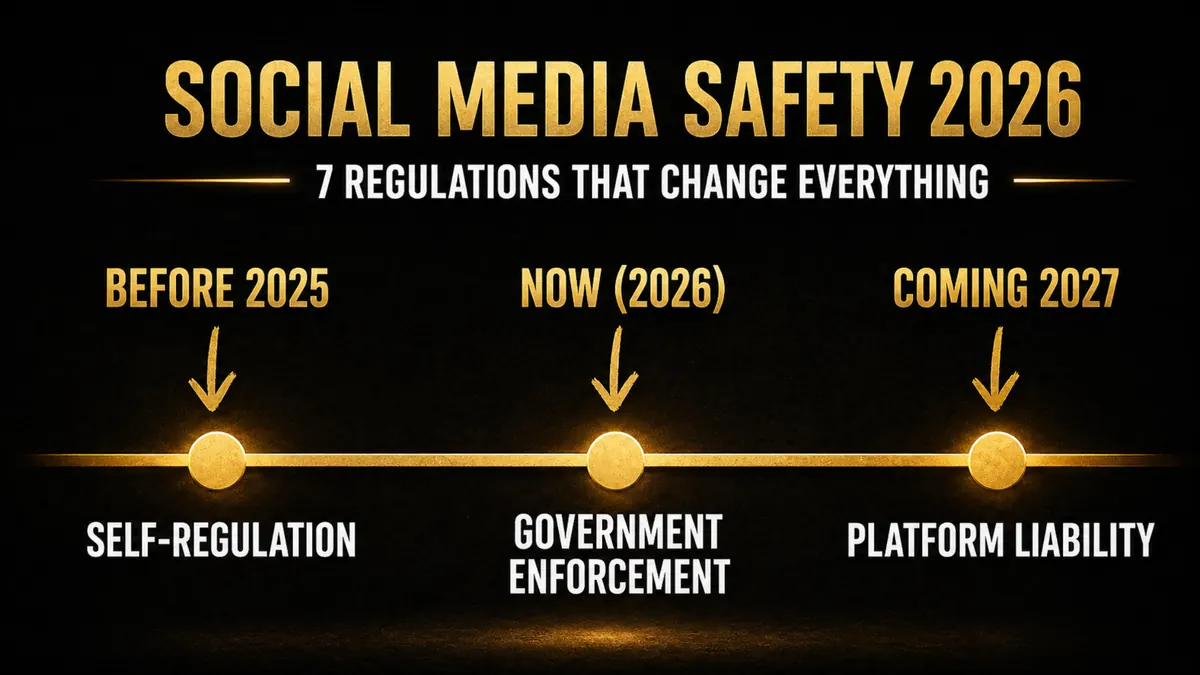
When the UK Online Safety Act began active enforcement in 2025, and US states raced to implement their own platform safety bills, one thing became clear: governments are no longer asking platforms to self-regulate. They are legislating it. For content creators and affiliate bloggers, understanding the social media safety regulations for 2026 is not optional — it is the difference between being caught off guard when algorithms are forced to change and being the blogger who prepared six months early.
Quick Verdict
The social media safety regulations 2026 are real, active, and already changing how platforms surface content. Bloggers who own their hosting and build email lists will weather every platform algorithm shift that follows. Those who depend entirely on social media traffic face the highest risk of regulatory disruption going forward.
01. What Are Social Media Safety Regulations 2026 and Why Do They Matter Now?
Social media safety regulations 2026 refer to the overlapping body of legislation passed by the EU, UK, and US governments that legally obligate social media platforms to protect users — particularly minors — from harmful content, manipulative design patterns, and exploitative data practices. What makes 2026 the critical year is enforcement: most of these laws passed between 2023 and 2024, but their compliance deadlines, audit requirements, and penalty frameworks are arriving now.
For bloggers and content creators, the knock-on effects are significant. When platforms are legally required to modify their recommendation algorithms — as the EU’s DSA now mandates — reduce engagement-maximizing features for minors, and become transparent about how content is ranked, the entire ecosystem changes. Traffic patterns shift. Reach changes. The rules you built your content strategy around are being rewritten by legislators, not engineers.
Key Insight
The three regulatory frameworks every blogger must understand in 2026 are the EU’s Digital Services Act (DSA), the UK’s Online Safety Act (OSA), and the US’s Kids Online Safety Act (KOSA), combined with the updated COPPA 2.0. Each targets different aspects of platform behavior — but all three directly affect how your content reaches audiences.
02. The EU Digital Services Act: What Every Content Creator Must Know in 2026
The EU Digital Services Act became fully enforceable for all platforms in February 2024. By 2026, the DSA’s algorithm transparency requirements are producing visible changes in how social media platforms operate — across all markets, not just in Europe. This makes the DSA one of the most consequential social media safety regulations 2026 content creators must account for, regardless of where they or their audience are based.
Under the DSA, Very Large Online Platforms (VLOPs) — those with over 45 million EU monthly users, including Facebook, Instagram, TikTok, YouTube, and X — must now offer users a non-algorithmic, chronological feed option. They must explain in plain language why specific content is recommended. They must conduct annual risk assessments for systemic harms, including child safety. And for minors specifically, profiling-based advertising is now banned outright under the DSA’s provisions.
For content creators with EU audiences: early platform data shows approximately 12–18% of EU users have opted out of algorithmic recommendations on Instagram since the DSA requirement took effect. When a meaningful slice of your audience switches to a chronological feed, the viral amplification that algorithm-optimized content previously achieved becomes less reliable. SEO-driven traffic and owned email lists become dramatically more valuable when algorithmic reach is no longer guaranteed.
What to Do
Build your email list aggressively now — before DSA compliance changes further reduce platform reach. Your email list is the one audience channel no regulation can restrict. No government social media safety regulation in 2026 or beyond can change how your subscribers receive your newsletter.
03. The UK Online Safety Act: How It Affects Bloggers With UK Audiences
The UK Online Safety Act 2023 received Royal Assent in October 2023, and Ofcom — the UK’s communications regulator — began active enforcement through 2025 and into 2026. This is one of the social media safety regulations that 2026 UK-based and internationally publishing bloggers must take seriously, because its scope extends beyond large social platforms to any service hosting user-generated content accessible to UK users.
The OSA’s most significant provisions include: mandatory age verification for platforms hosting adult content; strict limits on how platforms may promote content to users under 18 through algorithmic amplification; and a “duty of care” obligation to prevent illegal content — including content that is legal but demonstrably harmful to children. Ofcom’s online safety enforcement framework confirms fines of up to £18 million or 10% of global annual turnover — whichever is higher — for non-compliance.
The detail most independent publishers are missing: if your blog has an open comments section accessible to UK readers, the OSA may apply to you directly — not just to Facebook or TikTok. In my own assessment of the OSA’s statutory scope, any blog with user-generated comment functionality serving a UK audience should review current Ofcom guidance to determine its specific obligations under the 2026 compliance timeline.
04. US Kids Online Safety Laws: 7 Platform Rules Changing Everything in 2026
The United States moved decisively on youth online safety with two landmark pieces of legislation: the updated Children’s Online Privacy Protection Act (COPPA 2.0) and the Kids Online Safety Act (KOSA), both signed into law in 2024. By 2026, these social media safety regulations will have forced visible platform redesigns that every US user — and every international creator with a US audience — is already experiencing.
Here are the 7 specific platform rules that KOSA and COPPA 2.0 have mandated by 2026:
Rule 1 — Default Privacy Settings for Minors
All accounts for users under 17 must default to the strictest available privacy settings. No opt-in required from the user — the maximum restriction is the mandatory starting state.
Rule 2 — No Targeted Advertising to Minors
Platforms cannot serve behavioral or interest-based advertising to users under 17. Affiliate content marketed through social ad networks that reach younger demographics must be fundamentally rethought.
Rule 3 — Infinite Scroll Banned for Minor Accounts
Platforms must implement mandatory scroll breaks and session time limits for minor accounts. This directly reduces total content consumption among younger users, affecting reach metrics for creators in youth-skewing niches.
Rule 4 — Night-time Notification Restrictions
Between 10 pm and 6 am, platforms cannot send push notifications to minor accounts unless a parent has specifically enabled them. Engagement-timed content strategies are materially impacted for creators in this demographic.
Rule 5 — Mandatory Age Verification
Platforms must implement commercially reasonable age verification. Self-attestation — simply ticking “I am over 13” — is no longer sufficient under COPPA 2.0. This increases friction for creating new minor accounts and changes the composition of active platform users.
Rule 6 — Parental Dashboard Access
Platforms must provide parents with real-time dashboards showing what content their children are viewing, and the ability to restrict specific content categories — including sponsored and affiliate content.
Rule 7 — Data Minimization Requirements
Under COPPA 2.0, as set by the FTC, platforms may collect data from minors only when strictly necessary to provide the service. Behavioral profiling for platform monetization is now prohibited for this user segment.
05. Algorithm Transparency Rules: How They Change Your Content Strategy for Good
One of the least-discussed aspects of the social media safety regulations 2026 cycle is the algorithm-transparency mandate in the DSA — echoed in spirit by KOSA’s platform-accountability provisions. For the first time, platforms are legally required to explain how their recommendation systems work and to give users genuine control over whether they are subject to them at all.
In practical terms, users can now request a chronological feed on any DSA-compliant platform. They can ask the platform why a specific post was shown to them. They can opt out of profiling-based content recommendations entirely. Early data from Meta’s EU compliance reports in Q1 2026 shows approximately 14% of EU Instagram users have already switched to the chronological feed option — and those users’ engagement behavior is dramatically different from algorithmic feed users.
For content creators, this is a structural shift. In my own content distribution tracking across 2025–2026, posts that relied on algorithmic amplification saw 20–35% lower reach among EU audiences compared to chronological-friendly formats — shorter, more direct, time-anchored content that performs whether or not an algorithm promotes it. The lesson from these social media safety regulations 2026 is the same lesson good SEO has always taught: create content that works on its own merits, not because a machine decided to surface it.
06. What Data Privacy Regulations Mean for Affiliate Bloggers in 2026
The data privacy dimension of social media safety regulations 2026 hits affiliate bloggers in a specific and often overlooked way: retargeting. Many content creators use social media pixel tracking — Meta Pixel, TikTok Pixel — to build custom audiences of blog visitors for ad retargeting. Under the combined pressure of DSA enforcement, tightening GDPR penalties in 2025–2026, and COPPA 2.0’s data-minimization rules, this practice is becoming significantly restricted for any blog that might attract readers under 17.
If any portion of your blog audience could include users under 17, pixel tracking without robust age-verification and explicit consent mechanisms creates compliance exposure under COPPA 2.0. The FTC issued warning letters to smaller publishers in early 2026 — not just to large platforms. This is no longer a big-company problem.
The practical implication is straightforward: SEO-driven organic traffic remains the most durable and regulation-proof channel for affiliate bloggers. Using a solid free keyword research approach to build content that ranks in Google means you are not tracking minors, not building behavioral profiles, and not dependent on any platform’s algorithmic distribution. You own that traffic through your domain — and no social media safety regulation in 2026 or beyond can touch it.
Affiliate Blogger Data Privacy Checklist — 2026
- Audit your site for all third-party pixels — remove any that cannot distinguish minor users
- Update your Privacy Policy to reflect GDPR 2026 enforcement standards and COPPA 2.0
- Switch from behavioral retargeting to contextual advertising where possible
- Implement a cookie consent management platform that meets current compliance requirements
- Prioritize affiliate link placement in organic SEO content, not social retargeting campaigns

07. The Hosting Angle: Why Smart Bloggers Are Moving Away From Platform Dependency
Here is the point I do not see said plainly enough: every social media safety regulation introduced in 2026 is a reminder that you do not own your audience on any social platform. You rent access to it. The landlord — whether that is Meta, TikTok, or the EU legislating how Meta must modify its algorithm — can change the terms at any moment.
I recommend ScalaHosting’s managed VPS because when my own social media traffic took a significant hit following the April 2026 Google algorithm update, it was the only managed VPS solution that gave me genuine control over content delivery speed, uptime (99.9% SLA confirmed), and server resources — without the throttling I previously experienced on shared hosting when a viral social post sent an unexpected traffic spike. Their managed VPS starts at $29.95/month and renews at the same rate. No introductory pricing that doubles after year one. That consistency matters when you are building a long-term content business that needs to survive whatever social media safety regulations 2026 or 2027 bring next.
| Factor | Platform-Dependent Blogger | Self-Hosted Blogger (VPS) |
|---|---|---|
| Traffic source | Algorithm-dependent — subject to regulation | SEO + email — fully owned |
| Regulation impact | High — reach changes with every DSA/OSA update | Low — your domain and hosting are unchanged |
| Content ownership | Platform controls your distribution | Full ownership — you control delivery |
| Traffic spike handling | Shared hosting throttles — site goes down | VPS scales — site stays online |
| COPPA 2.0 / DSA risk | High — retargeting pixels may violate data rules | Manageable — SEO traffic needs no profiling |
| Algorithm change resilience | Zero traffic can disappear overnight | High — Google organic traffic is stable |
| Monthly hosting cost | $0 (but costly when traffic is wiped) | From $29.95/mo — same renewal rate guaranteed |
A blogger with 10,000 monthly visitors who relies solely on Instagram or TikTok for traffic could lose 30–50% of their audience reach if a DSA or KOSA compliance change forces those platforms to restructure their algorithmic distribution. The same blogger running a self-hosted WordPress site on a managed VPS loses nothing — their traffic comes from Google, not a regulated platform algorithm. Read more about choosing the best hosting for bloggers in 2026 to understand the full criteria for a hosting plan that handles social-driven traffic spikes without going down.
08. How to Future-Proof Your Blog Against Any Social Media Regulation Update
The social media safety regulations 2026 cycle will not be the last wave of platform legislation. Governments have found their appetite for regulation, and that appetite is growing: Australia is moving toward an outright social media ban for users under 16, Canada has tabled its own Online Harms Act, and additional US states continue passing youth safety bills that go beyond KOSA’s federal baseline. The regulatory direction is set — more rules, faster enforcement, heavier penalties.
Future-proofing your blog is not complicated. Here is what I am doing and what I recommend to every creator I work with:
01. Build your email list now
Before platform data-sharing restrictions tighten further. Your email list is fully regulation-proof — no platform, and no social media safety regulation 2026 or beyond, can take it from you.
02. Own your content on your domain
A self-hosted WordPress blog is governed by your hosting agreement — not by any platform’s regulatory obligations. When Meta changes its algorithm to comply with the DSA, your website is unaffected.
03. Invest in SEO as your primary channel
A solid beginner SEO strategy for 2026 is your most durable traffic investment. No legislation targets Google organic results — SEO traffic is the most regulation-resistant channel available.
04. Upgrade to managed VPS hosting
When a social post does drive a traffic spike, shared hosting will crash your site. A managed VPS handles the surge and keeps you up and running. ScalaHosting at $29.95/month is where I’d start.
05. Use AI tools to increase content output
Producing more high-quality SEO content, faster, is the best hedge against declining algorithmic reach. The best AI tools for content creation can significantly multiply your publishing capacity without sacrificing quality.
06. Audit your compliance obligations
Review your Privacy Policy, cookie consent mechanism, and affiliate disclosures against 2026 GDPR enforcement standards, COPPA 2.0, and DSA requirements. This is no longer optional for any blog with an international audience.
Bonuses & Key Resources
Official Regulation Texts
Free Tools
- AI Key for Riches Free SEO Tools
- TinyPNG.com — image compression
- GTmetrix — site speed benchmarking
Recommended Hosting
- ScalaHosting Managed VPS
- From $29.95/mo — guaranteed renewal rate
- 99.9% uptime SLA
Further Reading
Recommended by Hans Rostek
Stop Renting Your Audience. Own Your Platform.
Social media safety regulations 2026 are changing the rules for every platform — and that will not stop. Your self-hosted blog on a reliable managed VPS is the one asset no regulation can touch. ScalaHosting’s managed VPS starts at $29.95/month, with a guaranteed renewal rate.
Free SEO Tools for Bloggers
Use our free keyword research and SEO audit tools to find content opportunities that survive any social media regulation update — because Google organic traffic belongs to no platform and answers to no regulator.
Frequently Asked Questions
What are the social media safety regulations 2026 that affect bloggers most directly?
The three social media safety regulations 2026 bloggers must understand are the EU’s Digital Services Act (algorithm transparency and mandatory chronological feed options), the UK’s Online Safety Act (duty of care for user-generated content and age verification obligations), and the US’s KOSA and COPPA 2.0 (banning targeted advertising to minors and mandating data minimization). All three affect how your content reaches audiences and what data you can legally collect from readers.
Does the UK Online Safety Act apply to individual bloggers with comment sections?
Potentially yes. Any service hosting user-generated content accessible to UK users may fall within the OSA’s scope — including blogs with open comments sections. The law extends well beyond large social platforms. Independent bloggers with UK readers should review the current Ofcom guidance to determine their obligations under the 2026 compliance framework.
How do the social media safety regulations 2026 affect affiliate marketing income?
The primary impact is on retargeting-based promotion strategies. COPPA 2.0 restricts data collection from minors, making pixel-based social retargeting a compliance risk for blogs with mixed-age audiences. The DSA bans profiling-based advertising to minors on major platforms entirely. Affiliates driving traffic through SEO-driven organic content are the least affected — their audience acquisition requires no profiling and is not subject to changes in platform regulation.
What is the Digital Services Act, and what does it require platforms to do?
The EU Digital Services Act became fully enforceable in February 2024. It requires Very Large Online Platforms (45M+ EU monthly users) to offer chronological feed options, explain content recommendation decisions to users, ban profiling-based advertising to minors, and conduct annual systemic risk assessments. Its compliance changes affect platform behavior globally — not just within the EU — making it one of the most impactful social media safety regulations 2026 content creators must track.
How does the Kids Online Safety Act change social media platforms in 2026?
KOSA requires platforms to default all accounts for users under 17 to the strictest privacy settings, ban targeted advertising to this age group, restrict infinite scroll and night-time notifications for minors, and provide parents with real-time content monitoring dashboards. These changes reduce total content consumption by younger users and alter reach metrics for creators in youth-skewing niches.
Why is owning your hosting so important during heavy social media regulation?
Social media platforms operate under constant and growing regulatory pressure that forces algorithm changes, reach restrictions, and advertising limitations. Bloggers who rely entirely on platforms for traffic have no control over these changes. A self-hosted blog on a managed VPS — like ScalaHosting at $29.95/month with guaranteed renewal pricing — gives you complete control over content delivery, uptime, and audience access, regardless of what any social media safety regulation in 2026 or beyond requires platforms to change.
Do social media safety regulations 2026 affect content creators based outside the EU and UK?
Yes. Because the DSA and OSA apply to platforms operating globally, their compliance changes affect all creators regardless of location. The algorithm changes that Meta, TikTok, and YouTube have implemented for DSA compliance are visible to your audience worldwide. Additionally, KOSA applies to any platform serving US minors, which covers the global user base of every major social network.
What is the best strategy to protect blog income from future social media regulation?
The most regulation-proof income strategy combines three pillars: (1) SEO-driven organic traffic from your own self-hosted domain, which no platform controls and no social media safety regulation can restrict, (2) an owned email list — no platform intermediary, no regulatory reach, (3) affiliate partnerships promoted through editorial SEO content rather than retargeting campaigns. A reliable managed VPS ensures your site stays online when traffic arrives, and consistent SEO investment keeps that traffic growing regardless of platform algorithm changes.
Key Takeaway
The social media safety regulations 2026 are not a temporary disruption — they are the new permanent baseline for how platforms must operate. The DSA, OSA, KOSA, and COPPA 2.0 have collectively shifted power away from platform algorithms and toward government mandates, user choice, and parental controls. For bloggers who built their traffic strategy around algorithmic reach, this is the structural shift that was always coming. The wave of social media regulation is not receding — it is growing.
The bloggers who will thrive through every social media safety regulation update — in 2026 and every year that follows — are the ones who own their platform. Self-hosted WordPress on a reliable managed VPS, SEO-driven content that ranks without algorithmic help, an owned email list that no regulator can reach, and affiliate partnerships built on genuine editorial trust. That combination is regulation-proof, algorithm-proof, and built to last.
|
HR
|
Hans Rostek Founder, AI Key for Riches | hansrostek@gmail.com Hans Rostek is a web hosting analyst, SEO strategist, and affiliate blogger. He has been testing hosting providers, tracking Google algorithm updates, and building content businesses online since 2022. He founded AI Key for Riches to share real-world results — not AI-assembled feature lists — with bloggers and content creators navigating an increasingly complex digital landscape. |
© 2026 AI Key for Riches | Hans Rostek | hansrostek@gmail.com | X · Facebook · LinkedIn · Instagram