

Publishing SEO content? You need hosting that doesn’t slow you down. ScalaHosting’s managed VPS delivers the speed Google expects — fully managed with SPanel, no WP-CLI headaches.
Keyword Research Tool: 7 Proven Steps to Rank (2026)
Most people use a keyword research tool wrong. They pick high-volume terms, write generic content, wait 90 days — and get nothing indexed. Here is the system that actually works in 2026.
Using a keyword research tool is the single highest-leverage move in SEO — but only when you use it correctly. This guide cuts past the basics. You will learn how to find keywords that are rankable for your actual domain authority, how to read the data that most beginners ignore, and how to turn keyword intelligence into pages that Google indexes, ranks, and sends traffic to.
Zero-click searches now account for roughly 65% of all Google queries in 2026. AI Overviews consume even more informational real estate. That is not a reason to give up on SEO — it is a reason to get precise with your keyword research tool and target the terms that still drive clicks. This guide shows you exactly how.
Start free with the KeyForRiches keyword research tool to find low-competition opportunities fast. When you are ready to scale: Semrush ($139.95/month) is best for content sites and PPC; Ahrefs ($129/month) wins for backlink research and competitor gap analysis. Both have databases over 27 billion keywords as of 2026.
01. What a Keyword Research Tool Actually Does (And Why Volume Is the Least Important Number)
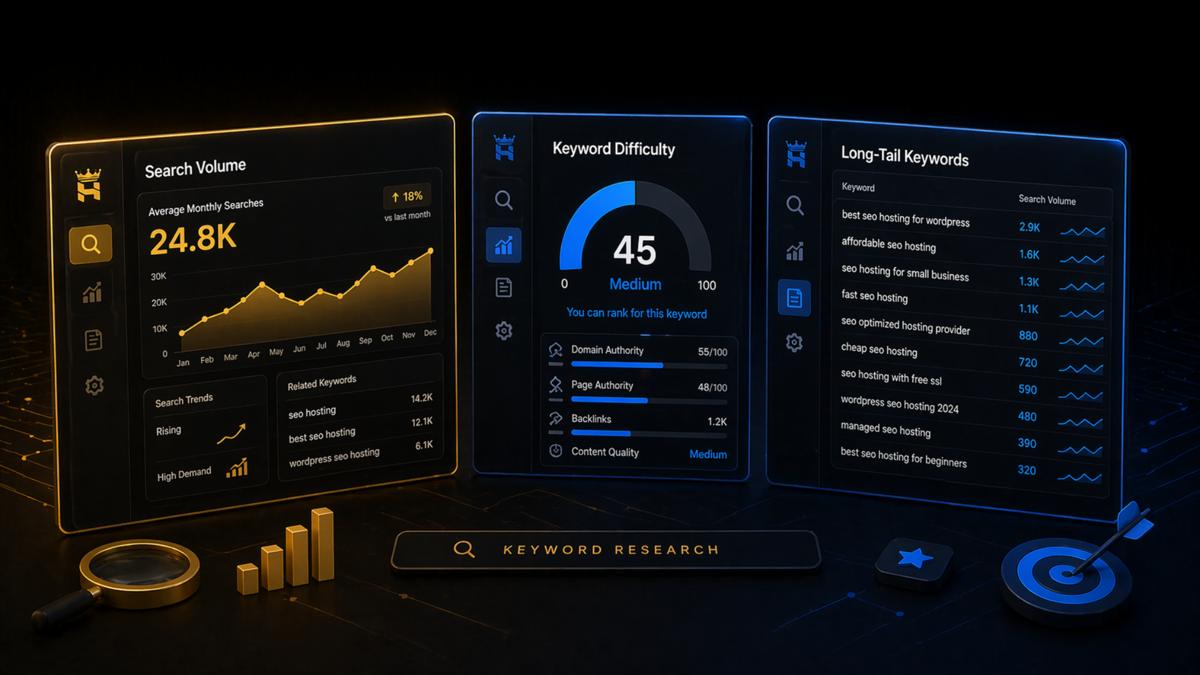
A keyword research tool finds the exact words and phrases people type into search engines. It returns data on how many monthly searches each term gets, how competitive it is to rank for, and increasingly in 2026 — the intent behind the search. That last metric is now the most important one.
Search intent tells you whether the user wants to learn something (informational), buy something (transactional), compare options (commercial), or navigate to a known page (navigational). A keyword research tool that shows intent classification — like Semrush’s Keyword Magic Tool — saves you from writing an article targeting a query where every top result is a product page. That mismatch is why most content fails to rank.
The three numbers that actually predict whether you can rank for a keyword are: keyword difficulty (KD), your domain rating (DR), and the click-through rate (CTR) for the top organic result. Search volume is a lagging indicator — a high-volume keyword you cannot rank for drives zero traffic. A 200-search/month keyword with KD 12 that you can hit position 3 for is worth far more.
02. How to Use the Free KeyForRiches Keyword Research Tool in 5 Steps
The free keyword research tool at tools.keyforriches.com is built for bloggers and content creators who need fast, actionable data without committing to a $130/month paid platform. Here is the exact workflow to get maximum value from it:

03. Keyword Difficulty Explained — The Number That Actually Predicts Your Ranking Chances
Keyword difficulty (KD) is a score from 0–100 that estimates how hard it is to rank in the top 10 for a given keyword. Every major keyword research tool calculates it differently, which is why the same keyword can show KD 28 in one tool and KD 54 in another. Neither is “wrong” — they measure different signals.
| KD Score | What It Means | Who Should Target It | Realistic Timeframe |
|---|---|---|---|
| 0–10 | Very low competition | Brand-new sites (DR 0–20) | 2–6 weeks |
| 11–30 | Low competition | Growing sites (DR 20–40) | 4–12 weeks |
| 31–50 | Moderate competition | Established sites (DR 40–60) | 3–6 months |
| 51–70 | High competition | Authority sites (DR 60–75) | 6–12 months |
| 71–100 | Very high competition | Major brands only (DR 75+) | 12+ months, if ever |
Ahrefs calculates KD primarily from the backlink profiles of the top-ranking pages — specifically, how many referring domains you would need to compete. Semrush uses a broader model that factors in content quality signals alongside backlinks. Neither is universally more accurate; the most reliable approach is to check KD in your keyword research tool, then verify the actual SERP manually before committing to write the content.
04. Free vs Paid Keyword Research Tools — What You Actually Get for the Money
Free keyword research tools are genuinely useful for finding opportunities — but they have hard limits. Here is an honest breakdown of what each tier delivers in 2026, so you can decide when upgrading actually makes sense for your stage.
| Tool | Price (2026) | Database Size | Best For | Key Limit |
|---|---|---|---|---|
| KeyForRiches Tool | Free | — | Beginners, quick lookups | No competitor analysis |
| Google Keyword Planner | Free | Google’s full index | PPC + basic SEO research | Rounded volume ranges |
| Ubersuggest | Free (3/day) / $29/mo | Mid-size | Bloggers, small sites | 3 free searches/day only |
| Ahrefs | $29 Starter / $129 Lite | 28.7B keywords | Backlinks + competitor research | No free trial |
| Semrush | $139.95/mo (Pro) | 27.9B keywords | Content sites, PPC, AI visibility | Expensive for solo creators |
| Moz Keyword Explorer | $99/mo | Large | Local SEO, beginners | Less data-rich than Ahrefs/Semrush |
05. Long-Tail Keywords — Why the Boring Searches Are the Most Valuable Ones
Long-tail keywords are search phrases of four or more words. They have lower individual search volume but vastly lower competition — and they signal a user who knows exactly what they want, which means higher click-through rates and better conversion rates than broad terms.
Any good SEO tool will surface long-tail variants automatically once you enter a seed term. The goal is to build a content cluster: one pillar page targeting a moderate-competition head term, supported by 4–8 long-tail pages that each target a specific variant. This cluster structure is why some sites dominate entire topic areas — they did not just write one article, they mapped every question a user might ask.
- free keyword research tool for bloggers
- how to find low competition keywords 2026
- best keyword research tool for beginners
- keyword research tool without subscription
- keyword research tool
- SEO tools
- keyword research
- best SEO software
06. Keyword Density and On-Page Optimisation — The Rules That Have Not Changed
Once your tool has given you a target keyword, on-page execution is what determines whether Google indexes and ranks your page. The rules are mechanical and non-negotiable regardless of how good your keyword selection was.
Keyword density is calculated against your actual final word count — not an estimate. Formula: (number of keyword uses ÷ total words) × 100. For a 2,600-word article targeting “keyword research tool,” you need 26–39 natural uses. Use Ctrl+F in your WordPress editor to count. If you are under 26, add the phrase to subheadings, the FAQ, and the conclusion. Never exceed 2.5% — Rank Math flags keyword stuffing and the score turns red.
07. Keyword Research for AI Search in 2026 — What Changes When Google Answers Before You Do
AI Overviews and zero-click searches have genuinely changed keyword research strategy in 2026. The old rule — target informational queries with high volume — now produces content that Google answers at the top of the page without users ever clicking through. You need to adapt your research workflow to account for this.
The terms that still drive clicks are: commercial comparison queries (“Semrush vs Ahrefs 2026”), specific how-to queries with steps (“how to export keywords from Ahrefs to Google Sheets”), review and recommendation queries (“best keyword research tool for affiliate marketers”), and transactional queries (“Semrush coupon code”). These query types require human judgment and nuance — AI Overviews cannot replace a well-researched comparison article.
When running your research, add a filter for commercial or transactional intent where your tool supports it. In Semrush, the Keyword Magic Tool now includes AI-driven intent classification — Informational, Navigational, Commercial, Transactional — for every keyword in the database. Filter for Commercial and Transactional intent to build a queue of click-driving content ideas. This is one of the clearest advantages paid SEO tools have over free alternatives in 2026. You can access a full suite of free SEO tools at tools.keyforriches.com to supplement this research at no cost.
Publishing SEO content at scale? Your hosting matters.
Once your keyword research tool is producing a steady queue of rankable targets, publishing speed becomes the constraint. ScalaHosting’s managed VPS is built for WordPress content sites — faster load times, no traffic bottlenecks, and SPanel that gives you full control without the command-line headaches.
08. The 7-Step Keyword Research Workflow — From Tool to Published Article
Here is the complete end-to-end system that combines your keyword research tool with content production. This is the workflow that moves the needle — not keyword lists sitting in a spreadsheet.
- Beginner SEO Strategy for 2026 — The full system for new sites, from keyword research tool to first rankings.
- AI Content vs Manual Content Ranking — Real Data — Which performs better in Google after keyword research is done right.
- Cost of Backlinks (Pillar Post) — Once your keyword research tool finds your targets, backlinks close the gap.
- Ahrefs Free Keyword Generator — A solid free entry point to Ahrefs keyword data.
- Google Search Console — The free keyword research tool Google itself gives you for your own site’s data.
No subscription. No credit card. Find low-competition keywords for your content site in minutes.
Frequently Asked Questions — Keyword Research Tool
Conclusion — A Keyword Research Tool Is Only as Good as What You Do Next
Every tool on this list will surface the same raw data. The difference between sites that rank and sites that do not is the system layered on top: intent classification, SERP verification, content depth, on-page execution, and immediate indexing requests. Start with the free keyword tool to find your first wave of low-competition targets, follow the 7-step workflow above, and request indexing for every article you publish. That sequence — not the tool itself — is what builds traffic.
When your publishing velocity hits four or more articles per month and you need competitor gap analysis to find the next wave of opportunities, that is the right time to invest in Semrush or Ahrefs. Until then, the free tools are genuinely sufficient — the bottleneck is almost always content quality, not data access.
|
HR
|
Hans Rostek
Founder of AI Key for Riches. Hans writes about SEO strategy, AI tools, and content marketing for independent publishers. He has been building affiliate content sites since 2019 and publishes practical guides based on real-world testing — not recycled theory.
|