
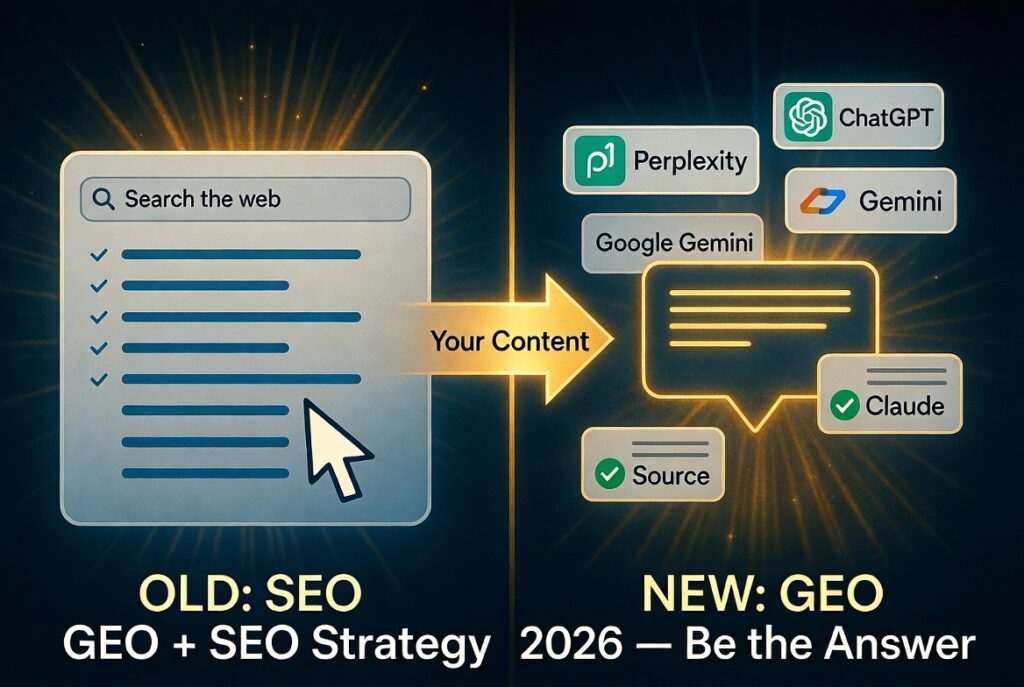
GEO SEO strategy 2026 is a combined approach to optimising content for both Google rankings (SEO) and AI citations (GEO — Generative Engine Optimisation), so that ChatGPT, Perplexity, Google Gemini, and Claude include your site in their answers. In 2026, these are no longer two separate goals — they are two layers of the same publishing strategy, and the bloggers who understand both now will dominate visibility in both channels for years.
Search is splitting into two distinct lanes. Classic search — “best hosting 2026,” “how to install WordPress” — is still SEO-driven and still huge. AI answers — “set up a VPS step by step,” “best AI tools for blogging” — are handled by generative engines that synthesise a full response and maybe, if your content is structured correctly, cite you as the source. You want to be in both lanes.
This guide explains exactly what GEO is, why it is not replacing SEO but extending it, and the nine steps you can take right now to make your existing and future content visible to both Google and AI systems simultaneously. For context on the broader AI landscape driving these changes, read the AI Tech Daily Trends 2026 pillar post.
Table of Contents
- What Is GEO? The Plain-English Definition
- GEO vs SEO: The Real Difference in 2026
- Why GEO SEO Strategy 2026 Is the Tipping Point
- How AI Systems Actually Pick Their Sources
- 9 Steps to a Winning GEO SEO Strategy 2026
- The robots.txt Fix Nobody Talks About
- What Is Actually Dying (and What Isn’t)
- How to Measure GEO Performance
- Platform Comparison: How Each AI Picks Sources
- Trusted External Resources
- FAQ: GEO SEO Strategy 2026
What Is GEO? The Plain-English Definition for the GEO SEO Strategy 2026
GEO stands for Generative Engine Optimisation. It is the practice of structuring your content so that AI-powered answer engines — ChatGPT, Perplexity, Google AI Overviews, Gemini, and Claude — can retrieve, understand, and cite it when answering a user’s question.
You may also see it referred to as AEO (Answer Engine Optimisation), LLMO (Large Language Model Optimisation), or AI SEO. The industry has not settled on one term. They all describe the same goal: get your content inside the AI’s answer, not just in the list of links below it.
When an AI says “According to AI Key for Riches…” before summarising your point, that is GEO working. You did not need the user to click. The AI already extracted your insight, attributed it to you, and delivered it directly. That is a different kind of visibility — and in many ways a more powerful one.
GEO is not brand new. Princeton University and IIT Delhi published foundational GEO research in 2024, finding that specific content strategies — citing sources, adding statistics, improving fluency — boost AI visibility by up to 40%. By 2026, those findings will have been validated across the industry at scale.
GEO vs SEO: The Real Difference in 2026
SEO and GEO are not competing strategies. They are layers. Understanding the difference helps you apply the right tactics to the right goal.
| Dimension | SEO (Classic Search) | GEO (AI Answers) |
|---|---|---|
| Goal | Rank in the list of blue links | Be cited inside the AI answer |
| User action | User clicks your link | User reads AI answer — may not click |
| Optimise for | Keywords, backlinks, UX | Structure, facts, extractability |
| Traffic metric | Clicks, sessions | Citation frequency, brand mentions |
| Content format | Long articles, pillar pages | Direct answers, definitions, lists, steps |
| Authority signal | Domain authority, backlinks | E-E-A-T, citations in trusted sources |
| Recency impact | Moderate | High — AI has strong recency bias |
The most important insight from this table: a single well-written article can satisfy both. The GEO SEO strategy 2026 is not about writing two types of content. It is about writing one piece of content with both audiences in mind — Google’s algorithm and the AI’s extraction engine.
Why GEO SEO Strategy 2026 Is the Tipping Point
The numbers make the urgency clear. According to Previsible’s 2025 AI Traffic Report cited by Frase.io, AI-referred sessions jumped 527% year-over-year in the first five months of 2025. Perplexity now processes over 780 million queries monthly. And 60% of Google searches in 2026 are zero-click — meaning the user gets the answer directly on the results page without visiting any site.
At the same time, Foundation Inc. reports that 55% of enterprise buyers now use AI to begin their search process. Nearly half use it for market research. This is not a future trend to plan for. It is the present reality to respond to.
The competitive window is still open. Digital Applied estimates that 47% of brands currently have no GEO strategy at all. That gap between early movers and the majority is exactly the kind of early-adopter advantage that defined the bloggers who dominated Google back in 2010–2012. The same opportunity is available now — but the window is closing.
How AI Systems Actually Pick Their Sources
Understanding how the technology works helps you write directly for it. When a user asks an AI a question, the process does not work like a Google search. According to LLMrefs, AI systems use a process called query fan-out: the full question is broken into smaller sub-queries, and each is searched separately. The AI then synthesises answers from typically 5 to 16 sources across all the sub-queries.
Different platforms prioritise differently:
- Perplexity AI — live-crawl focused, strong recency bias, leans heavily on community platforms (90%+) and current web results
- ChatGPT Search — retrieval-augmented, cites inline, favours well-structured pages and factual sources; Wikipedia accounts for ~48% of its top citations
- Google AI Overviews — closely correlated with organic search rankings; if you rank on page 1, you have a much higher chance of appearing in AI Overviews
- Google Gemini — relies far less on community platforms (~7%) versus Perplexity; favours authoritative domain sources
- Claude — trained on pre-cutoff data plus live retrieval; E-E-A-T signals and crawlability are key factors
The practical implication: no single optimisation wins across all platforms. Your GEO SEO strategy 2026 needs to build authority across multiple dimensions simultaneously. Fortunately, most of those dimensions overlap with what good SEO already asks for.
9 Steps to a Winning GEO SEO Strategy 2026
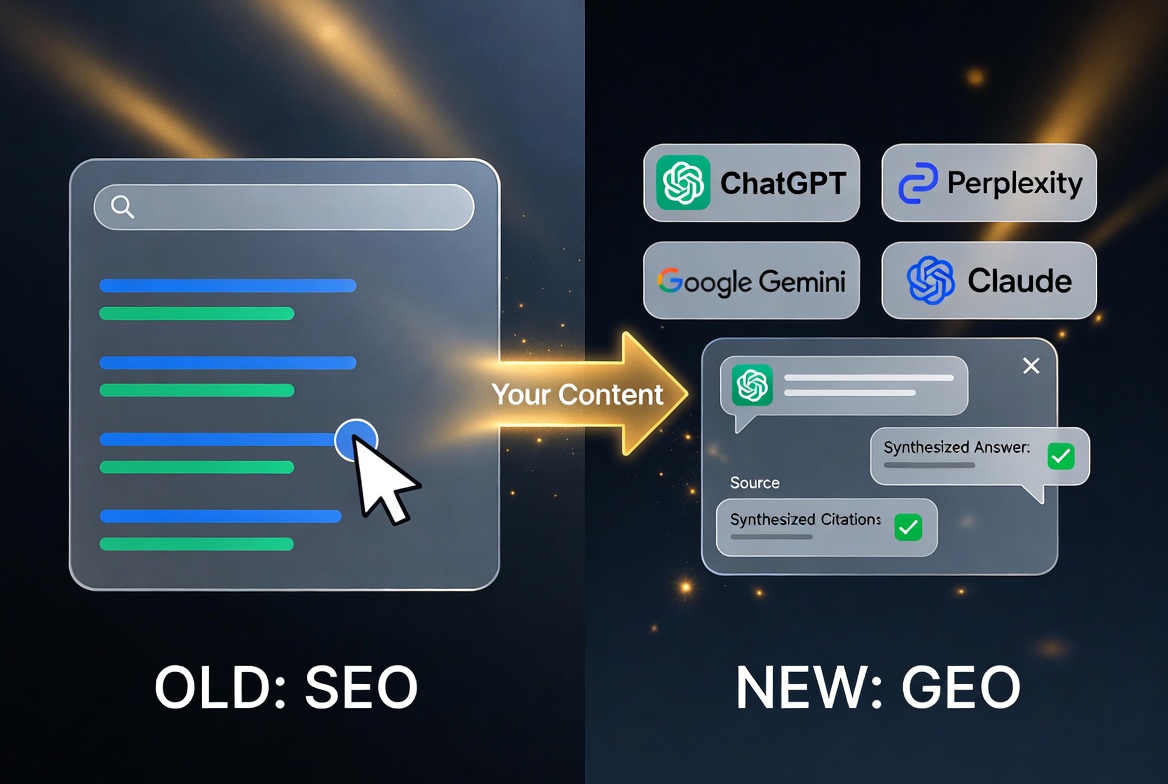
These steps are sequenced from the fastest wins (technical, zero-cost) to the longer-term authority builders. Apply them to your existing content first, then make them standard practice for all new articles.
Step 1: Lead with the Direct Answer (BLUF Format)
AI retrieval systems prefer the opposite of traditional journalistic writing. Instead of building up context before the answer, put the answer in the first paragraph. Research shows that approximately 44% of all AI citations come from the first 30% of an article. If your opening paragraph is a hook rather than an answer, AI crawlers move on before they find the substance.
This is called BLUF — Bottom Line Up Front. Every article, section, and FAQ answer should state its conclusion first, then support it. Notice how this guide opened: the definition of GEO SEO strategy 2026 appeared in the very first sentence. That is intentional.
Step 2: Structure Every Section as a Standalone Answer
AI systems do not cite entire pages. They extract individual passages. Each H2 and H3 section in your article should be self-contained — answering its own question clearly enough that the passage makes sense without the surrounding text. Think of every section as a potential standalone quote an AI could pull and attribute to you.
Use this pattern in every section: one focused question as the heading → direct answer in the first sentence → supporting detail → specific example or data point.
Step 3: Write in Definitive, Entity-Rich Language
Vague language gets ignored by AI. Definitive language gets cited. The Princeton GEO research confirmed that AI models are measurably more likely to cite content that uses clear entity references, specific facts, and straightforward sentence structures.
❌ “There are some things to think about when picking a control panel.”
✅ “DirectAdmin’s Standard license includes unlimited accounts for $29/month — compared to cPanel’s Pro tier at $53.99 for a maximum of 30 accounts.”
Named entities (product names, platforms, companies, specific figures) are signals that help AI models classify and retrieve your content accurately.
Step 4: Include Original Data, Statistics, and Real Examples
One of the clearest findings from GEO research: content with original data or cited statistics gets cited significantly more than content without them. The Princeton study found that adding statistics yielded a 15–30% increase in visibility. If you can publish original research, benchmarks, or first-hand test results, AI models have a strong reason to cite you over a dozen similar pages.
If you do not have original data, cite named third-party sources directly — “According to Gartner…” or “Perplexity processes over 780 million queries monthly, per Frase.io’s 2026 research.” Named attribution is itself a GEO signal.
Step 5: Use Questions as Headings
Users ask AI questions. So should your headings. Instead of “cPanel Alternatives,” write “What are the best cPanel alternatives in 2026?” Instead of “Benefits of GEO,” write “Why does GEO matter more than SEO in 2026?”
Question-format headings directly match the fan-out subqueries that the AI generates when processing a user’s question. A heading like “What is GEO SEO strategy 2026?” is literally the kind of sub-query that gets searched, and your answer immediately below it is the exact format AI looks for.
Step 6: Keep Content Fresh — AI Has a Strong Recency Bias
Unlike Google rankings, which can persist for years, AI citation data from LLMrefs shows that when content becomes more than three months old, AI citations drop off sharply. This is a meaningful structural difference between SEO and GEO.
Practical response: add a visible “Last updated” timestamp to important posts. Schedule a quarterly review of your top 10 articles. Update statistics, add new examples, and refresh the introduction to reflect the current context. A quick update signals recency to both Google and AI crawlers.
Step 7: Implement Schema Markup (FAQPage + Article)
Schema is one of the clearest technical signals you can send to both Google and AI systems. The FAQPage schema makes your Q&A content directly readable as structured data. Article schema establishes authorship, date, and publisher — all signals that improve AI attribution confidence.
Every article you publish should include both the FAQPage schema for the FAQ section and the Article schema for the page metadata. This is already part of Hans’s standard template — and it serves double duty as both a GEO signal and an SEO rich-snippet signal.
Step 8: Build Brand Authority Across Multiple Platforms
AI systems learn about your brand from the entire web, not just your own site. Unlinked mentions of your brand across the web — in forums, news articles, guest posts, and social discussions — carry weight in how AI models classify your authority. Search Engine Land confirms that GEO extends beyond your website into every source AI uses to understand your category.
Practical steps: publish guest articles on authoritative sites in your niche, participate in relevant forums (Reddit, Quora, niche communities), get your blog mentioned in roundup posts, and ensure your social media profiles are consistently branded and active.
Step 9: Target Both Channels with the Same Article
Here is the most liberating truth about the GEO SEO strategy 2026: you do not need to write different content for each channel. A well-structured, factual, answer-first article with schema markup, strong E-E-A-T signals, external citations, and a question-format heading hierarchy will rank well in Google AND get picked up by AI. The same content does both jobs — you just need to write it with both jobs in mind from the start.
The robots.txt Fix Nobody Talks About in GEO SEO Strategy 2026
This is the fastest, zero-cost GEO win available — and most blogs have not done it yet.
If AI crawlers are blocked in your robots.txt file, none of your content optimisation efforts will matter. You are completely invisible to those AI platforms, regardless of how well-structured your articles are. Many WordPress sites — especially those running Cloudflare — block AI bots without the site owner realising it. Cloudflare changed its default configuration to block AI bots, meaning millions of sites were silently cut off from AI indexing.
The key AI crawlers to explicitly allow in your robots.txt are:
- GPTBot — OpenAI training crawler
- OAI-SearchBot — ChatGPT live search retrieval
- ChatGPT-User — real-time fetch when users ask ChatGPT
- PerplexityBot — Perplexity AI crawler
- ClaudeBot — Anthropic training crawler
- Claude-SearchBot — Claude live search retrieval
- Google-Extended — Google AI training crawler (Gemini)
Add explicit Allow: / directives for each of these user agents in your robots.txt file. Check your Cloudflare dashboard under “AI Crawl Metrics” if you use Cloudflare. And look for these user agents in your server logs to confirm they are actually visiting your site.
A note on llms.txt: You may have read that adding a /llms.txt file is important for GEO. Current data suggest the impact is minimal — a study of 1,000 domains found that AI bots requested the file in fewer than 0.1% of visits. It is low-cost and low-risk to add, but it is not a substitute for proper robots.txt configuration and a solid content structure.
What Is Actually Dying in the GEO SEO Strategy 2026 Shift
The claim that “SEO is dying” is inaccurate. Classic search — “best hosting 2026,” “how to install WordPress,” “cPanel vs DirectAdmin” — is still enormous and still SEO-driven. Google’s index still matters. Backlinks still matter. Domain authority still matters.
What is genuinely dying is a specific style of content that relied on search to survive despite providing no real value:
- Thin affiliate articles with no original analysis — lists of products with vendor descriptions copied and reformatted
- “Top 10 tools” junk that simply recycles what is already published elsewhere
- Keyword-stuffed content where the focus keyword appears every other sentence but the actual substance is thin
- Mass AI-generated spam sites that flood the web with mediocre auto-generated articles to capture long-tail traffic
- Sites with no real expertise — no identifiable author, no first-hand experience, no original perspective
Google’s Helpful Content updates have already significantly deprioritised this type of content. GEO accelerates the same process because AI systems simply will not cite thin content — it lacks the entity-richness, factual density, and structural clarity that AI extraction requires.
Bad SEO is dying. Good SEO is evolving. The bloggers who will survive and grow in 2026 are the ones whose content would still be worth reading even if Google did not exist.
How to Measure GEO Performance in 2026
GEO measurement is the biggest gap in most strategies today. Traditional analytics — sessions, pageviews, bounce rate — do not capture AI visibility because most AI citations are zero-click. The user never visits your site.
The key metrics to start tracking for your GEO SEO strategy 2026:
- Citation frequency — manually ask ChatGPT, Perplexity, and Gemini your target questions, and check if your site is cited. Do this monthly for your top 10 target queries.
- Share of model — across your category, how often is your brand mentioned vs. competitors in AI answers?
- Brand mention tracking — set up Google Alerts and use tools like Otterly.ai or Semrush’s AI visibility dashboard to track where your brand is being cited across AI platforms.
- GA4 referral source tracking — some AI platforms do pass referral data. Set up a segment in GA4 for referrals from perplexity.ai, chatgpt.com, and bard.google.com.
- Server log AI bot monitoring — check that GPTBot, PerplexityBot, ClaudeBot, and Google-Extended are appearing in your logs. If they are not, something is blocking them.
Platform Comparison: How Each AI Picks Sources in 2026
| AI Platform | Retrieval Method | What It Prioritises | Best GEO Tactic |
|---|---|---|---|
| Perplexity AI | Live web crawl | Recency, community sources (90%+) | Update content quarterly; build Reddit/Quora presence |
| ChatGPT Search | RAG — real-time + trained | Wikipedia-style factual pages (~48%); structured content | BLUF answers; cite named sources; FAQPage schema |
| Google AI Overviews | Search-correlated | Organic ranking position strongly correlated | SEO-first; page 1 ranking is the best GEO signal |
| Google Gemini | Training + retrieval | Authoritative domains; low community-source weighting (~7%) | E-E-A-T, author pages, domain authority |
| Claude | Training + live search | Pre-cutoff E-E-A-T signals; crawlable content | Allow ClaudeBot in robots.txt; strong author bylines |
Trusted External Resources: GEO SEO Strategy 2026
| Resource | Why It Matters | Link |
|---|---|---|
| Princeton GEO Research (KDD ’24) | Original academic paper defining GEO and testing 9 optimisation methods | arxiv.org |
| Search Engine Land — GEO Guide | Industry-standard framework for 2026 GEO strategy | searchengineland.com |
| Frase.io GEO Guide | Platform-specific tactics and AI traffic data | frase.io |
| Foundation Inc. GEO Report | Enterprise adoption data and multi-platform strategy | foundationinc.co |
| LLMrefs.com — AI Crawler Guide | Technical robots.txt and crawlability best practices | llmrefs.com |
| Otterly.ai | Tool to track AI citation frequency across platforms | otterly.ai |
| Semrush AI Visibility | Enterprise GEO monitoring and competitor benchmarking | semrush.com |
| Wikipedia — GEO Definition | Authoritative definition — the kind AI itself cites | wikipedia.org |
🔑 Key Takeaways: GEO SEO Strategy 2026
- GEO (Generative Engine Optimisation) = structuring content so AI systems cite it in their answers.
- SEO = get the click. GEO = be the answer. One article can do both.
- AI-referred sessions grew 527% year-over-year in 2025. 47% of brands have no GEO strategy.
- The fastest GEO win: check your robots.txt — if AI crawlers are blocked, nothing else matters.
- Lead every section with the direct answer. Use question-format headings. Add named statistics.
- Update content at least every quarter — AI has a strong recency bias.
- Schema markup (FAQPage + Article) serves both SEO rich snippets and AI extraction.
- Bad SEO is dying. Good SEO — factual, structured, expert, original — is evolving into GEO.
Explore Free AI & Website Tools
FAQ: GEO SEO Strategy 2026 — 8 Essential Questions
1. What does GEO stand for in the GEO SEO strategy 2026?
GEO stands for Generative Engine Optimisation. It is the practice of structuring content so that AI-powered answer engines — ChatGPT, Perplexity, Google AI Overviews, Gemini, and Claude — retrieve it and cite it in their generated answers. It is also called AEO (Answer Engine Optimisation) or LLMO (Large Language Model Optimisation).
2. Is SEO dying because of GEO?
No. Classic search — “best hosting 2026,” “how to install WordPress” — is still enormous and still SEO-driven. What is dying is thin, low-value content that relied on search volume alone to survive. Good SEO — factual, well-structured, authoritative content — is the same foundation GEO requires. Both disciplines reward the same quality signals.
3. How is GEO different from SEO?
SEO optimises for a click from a search results page. GEO optimises for citation inside an AI-generated answer — often with no click required. SEO measures sessions and rankings. GEO measures citation frequency and brand share of models across AI platforms. The content structure and authority signals overlap, but GEO adds specific requirements around answer-first formatting, factual density, and schema markup.
4. What is the single fastest GEO win for a blogger in 2026?
Check your robots.txt file and Cloudflare settings for blocked AI crawlers. If GPTBot, PerplexityBot, ClaudeBot, OAI-SearchBot, or Google-Extended are blocked, you are invisible to those AI platforms regardless of content quality. Adding explicit Allow directives takes five minutes and has an immediate impact.
5. How often do I need to update content for GEO?
At least once every three months for your most important articles. AI systems have a strong recency bias — citation data shows that content older than three months receives significantly fewer AI citations. Add a visible “Last updated” timestamp, refresh your statistics, and update examples to reflect the current context.
6. Does schema markup help with GEO?
Yes. The FAQPage schema makes your Q&A content directly readable as structured data for both Google and AI systems. Article schema establishes authorship, date, and publisher — signals that improve AI attribution confidence. Every article should include both the FAQ page and the Article schema as standard practice.
7. Which AI platform is easiest to get cited in?
Perplexity AI is generally the most accessible starting point because it relies heavily on live web crawl and has a strong recency bias. Fresh, well-structured content on a crawlable site can appear in Perplexity citations relatively quickly. Google AI Overviews is most closely correlated with existing organic rankings — if you are on page 1 in Google, your chance of AI Overview citation is high.
8. Can one article rank in Google AND get cited by AI?
Yes — and this is the core insight of the GEO SEO strategy 2026. A single well-structured, factual, answer-first article with schema markup, strong E-E-A-T signals, and question-format headings will serve both channels. You do not need to write separate content for SEO and GEO. You write the same article with both audiences in mind: Google’s algorithm and the AI’s extraction engine.