
AI-Driven SEO Tools Without Ranking Loss
AI-driven SEO tools can speed up keyword research, content planning, and on-page SEO.
But if you publish content without editing and proofreading, you can lose trust and rankings.
This guide explains how to use AI-driven SEO tools safely and effectively in 2026.
In simple terms, AI-driven SEO tools help you find opportunities faster, write better briefs, and spot SEO issues before they hurt your rankings.
The New Reality: AI Is Changing SEO (Even If You Don’t Use It)
You can ignore AI tools, but you cannot ignore AI-powered search. Search engines now use AI to answer questions directly in the results.
AI Overviews and the rise of “zero-click” behavior
Google is increasingly answering questions directly in the results. Great for users… emotionally devastating for anyone who enjoys website traffic.
2025 industry roundups compiling clickstream and SERP behavior data show a large share of searches end without a click (“zero-click searches”). (Examples: AIOSEO statistics roundup; SEO Sherpa statistics roundup)
Ahrefs brings the spicy numbers:
-
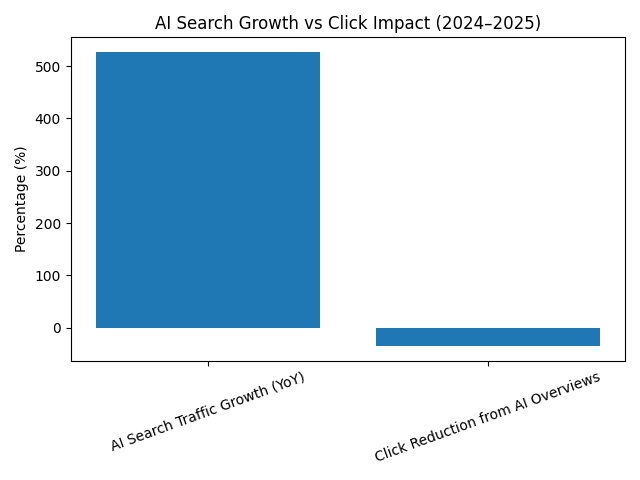
- According to Ahrefs’ 2025 AI SEO study, pages shown under AI Overviews receive approximately 34.5% fewer clicks compared to traditional organic results.
Source: https://ahrefs.com/blog/ai-seo-statistics/
- AI Overviews pull citations heavily from already-ranking pages
So yes, traditional rankings still matter—but the payoff is shifting from clicks to visibility.
Takeaway: Your page can “win” the SERP and still feel like it lost. Welcome to 2026.

AI search traffic is growing fast—but it’s still small compared to Google
Semrush reports that AI-powered search traffic (including referrals from ChatGPT, Gemini, and Perplexity) increased by 527% year-over-year, based on aggregated traffic trend analysis from 2024–2025.
Source: Semrush AI SEO Statistics (2025)
That’s a rocket ship.
But Ahrefs notes that Google still sends dramatically more traffic than AI chat tools (ChatGPT/Gemini/Perplexity referrals are growing, but from a smaller base). (Sources: Semrush; Ahrefs)
Practical takeaway: Treat AI referrals like a high-potential side hustle, not your primary paycheck. Google still pays the bills—just with more fine print than before.
What “AI-Driven SEO Tools” Actually Mean (Beyond the Buzzword)
In practice, AI-driven SEO tools combine keyword data, competitor analysis, and automation to reduce manual workload.
An “AI-driven SEO tool” usually isn’t a robot that understands your niche.
It’s more like this: Classic SEO data (keywords, SERPs, backlinks, crawling, content gaps) + machine learning / generative AI = faster decisions and faster execution.
These AI SEO tools help you:
- Find opportunities faster (keywords, topics, SERP patterns)
- Generate and optimize drafts (briefs, outlines, rewrites)
- Scale analysis (audits, internal links, competitor comparisons)
- Prioritize work (what’s likely to move the needle)
AI tools do not replace SEO fundamentals. They save time on repetitive tasks like keyword grouping, draft creation, and content audits. However, they still require human review to prevent errors.
Takeaway: AI can be your power tool. It can also remove your thumb. Use responsibly.
The Most Useful Capabilities of AI-Driven SEO Tools (Ranked by Real Impact)
Not all AI features deserve a parade. Some are game-changers. Some are glitter cannons.
1) AI-assisted keyword research and intent mapping
Modern AI-driven SEO tools cluster keywords by intent and suggest supporting subtopics, which helps you build pages the SERP actually rewards.
A solid AI keyword workflow helps you:
- Group keywords into topic clusters (not just single phrases)
- Separate informational vs. commercial intent
- Identify content gaps across your site vs competitors
Why it matters now: AI Overviews and SERP features tend to favor pages that answer related questions cleanly and comprehensively.
Takeaway: Stop collecting keywords like Pokémon. Start organizing them like adults who want rankings.
2) Content briefs and on-page optimization that reflect real SERPs
Tools like Surfer SEO and Semrush’s content features got popular for a reason: they reverse-engineer what already ranks and suggest:
- Terms to cover
- Heading structures
- Length ranges
- Related questions
- Internal link ideas
Used correctly, it improves completeness and relevance. Used poorly, it creates “SEO Mad Libs” where every paragraph reads like a sentient toaster wrote it.
Takeaway: Optimize for humans first. Then sprinkle in the SEO. Not the other way around.
3) Technical SEO automation (audits, prioritization, internal linking)
AI is quietly excellent at the unsexy stuff:
- Flagging issues and prioritizing what to fix first
- Suggesting internal links based on topical similarity
- Summarizing crawl data into actions that don’t require a decoder ring
This is often overlooked because technical debt quietly erodes performance—like a slow drip under the sink that becomes a swamp.
Takeaway: Fancy content won’t outrank a site that’s technically healthier forever. Eventually, the bill comes due.
4) Optimization for “answer engines” (AEO) and brand mentions
With AI Overviews and AI answers everywhere, SEOs are adapting by writing content that’s easier to cite:
- Clear definitions and direct answers near the top
- Structured data (when relevant)
- FAQ-style coverage matching how people ask questions
Even if you don’t get the click, being cited can influence trust and later demand.
Takeaway: Sometimes the new “conversion” is mentioned in the room where decisions are made.
Real-World Data Points You Should Know (Because They Affect Strategy)
Here are the key statistics shaping SEO strategy in 2025:
- AI Overviews reached over 1.5 billion users per month in Q1 2025, according to Ahrefs’ 2025 AI SEO study,
and pages shown in AI Overviews receive approximately 34.5% fewer clicks. - AI search traffic increased 527% year-over-year (Semrush)
Multiple 2025 SEO industry roundups, including AIOSEO, SEO Sherpa, and Ahrefs, indicate that AI-assisted workflows are now widely used among ranking pages. However, rankings still correlate more strongly with relevance, authority signals, and intent satisfaction than with whether AI was used.
Important nuance: This doesn’t mean “AI content ranks.” It means AI-assisted workflows are everywhere, and ranking pages still align with usefulness, authority signals, and intent satisfaction—not whether a human sweated over every adjective.
Takeaway: Google doesn’t care if you used AI. Google cares if your page is helpful… and not full of nonsense.
Google has repeatedly stated that it evaluates content based on helpfulness and quality, not the production method. In its Search Central guidance, Google confirms that AI-generated content is acceptable if it demonstrates experience, expertise, authoritativeness, and trustworthiness.
(Source: https://developers.google.com/search/docs/fundamentals/creating-helpful-content)

Popular AI-Driven SEO Tools (and What They’re Best For)
This isn’t “here are 47 tools you’ll never log into again.” These are widely used platforms with AI features and real SEO data.
Ahrefs (AI insights + link/keyword intelligence)
Ahrefs is known for backlinks and keyword research, and it has published strong analyses on AI Overviews, click behavior, and AI referral traffic.
Best for:
- Competitive keyword research + content gaps
- Backlink analysis + authority building
- Understanding the changing click landscape via industry research
Takeaway: If SEO were a detective show, Ahrefs is the one finding the clues… and quietly judging your internal links.
Semrush (AI features layered onto a full SEO suite)
Semrush is the Swiss Army knife: keywords, audits, content planning, reporting, and AI sprinkled throughout. They’ve also published stats on AI search growth.
Best for:
- End-to-end SEO management
- Content planning at scale
- Team workflows where one platform needs to do “most things”
Takeaway: If you like one dashboard to rule them all, this is your “control room.”
Surfer SEO (AI-driven content optimization)
Surfer is popular for content briefs, on-page recommendations, and refreshing existing posts based on SERP patterns.
Best for:
- Content briefs and outlines
- On-page coverage improvements
- Updating older content to better match intent + competitors
Takeaway: Great for editing. Dangerous for writers who treat “NLP terms” like a personality.
How to Use AI SEO Tools Without Publishing “Scaled Content” That Gets Ignored
If you treat AI like a content vending machine, Google will treat your site like a vending machine too: ignored unless someone is desperate at 2 a.m.
Here’s a workflow that keeps you fast and credible.
Step 1: Start with SERP truth, not AI guesses
Before generating anything:
- Inspect the top-ranking pages
- Identify intent (guide, list, product page, category page)
- Note SERP features (AI Overviews, featured snippets, PAA)
Use AI to summarize patterns—but don’t let it invent them.
Takeaway: The SERP is reality. AI is a commentary on reality.
Step 2: Use AI for structure, then add experience and proof
The winning combo:
- AI generates: outline + FAQs + headings
- Human adds: real examples, screenshots, quotes, pricing notes, firsthand steps, original visuals, editorial judgment
This aligns with Google’s long-running vibe: helpful, people-first content—not content made to manipulate rankings.
Takeaway: AI can set the table. Humans cook the meal.
Step 3: Build “citation-ready” sections
If AI Overviews cite sources (and Ahrefs notes citations overlap heavily with top rankings), make your content easy to quote:
- One-paragraph definitions
- Bullet lists with clear criteria
- Short step-by-steps
- Tables comparing options
This helps humans scan, and machines extract.
Takeaway: If you want to be cited, write like you’re about to be quoted.
Step 4: QA like a publisher, not a prompt engineer
Before publishing, validate:
- Claims and numbers (link the original sources)
- Product feature accuracy (tools change constantly)
- Internal linking + canonical intent (avoid keyword cannibalization)
- Tone (remove robotic filler and “in today’s world” nonsense)
If you can’t verify a claim, remove it.
Takeaway: “Looks plausible” is not a citation.

Where AI-Driven SEO Tools Commonly Fail (So You Can Avoid It)
Even good tools can faceplant. Common failure modes:
- Hallucinated facts in AI drafts (especially “stats” and “case studies”)
- Over-optimization that kills readability
- Generic content that matches competitors but doesn’t surpass them
- Misread intent, writing a blog post when the SERP wants a landing page
Rule of thumb: Use AI to increase speed. Use human review to protect accuracy.
Takeaway: Speed is a strategy. Accuracy is a moat.
Conclusion: Using AI-Driven SEO Tools Without Ranking Loss
Key Takeaway: AI-driven SEO tools can improve speed and efficiency, but they do not replace strategy, accuracy, or experience.
When used correctly, AI-driven SEO tools help with keyword clustering, content briefs, technical audits, and answer engine optimization. When used blindly, they create generic content that fails to stand out.
The difference is not the tool. The difference is how you use it.
Ready to build a stronger system? Start by auditing your top pages, updating weak sections with structured data and tables, and tightening internal links across your content cluster.
You may also want to review our SEO strategy guide to avoid keyword cannibalization and structural issues:
COMPLETE GUIDE for a Beginner SEO Strategy for 2026
.
Frequently Asked Questions About AI-Driven SEO Tools
Do AI-driven SEO tools improve rankings automatically?
No. AI-driven SEO tools improve efficiency, but rankings still depend on content quality, relevance, backlinks, and technical SEO.
Can AI-generated content rank in Google?
Yes, if it meets Google’s quality standards. Google evaluates helpfulness and expertise, not whether content was written by AI.
What is the biggest risk of using AI for SEO?
The biggest risk is publishing unverified or generic content. AI can produce inaccurate data if not reviewed by a human editor.
How do AI-driven SEO tools help with keyword research?
They cluster keywords by topic and intent, helping you create comprehensive pages instead of targeting isolated keywords.
Do AI tools replace technical SEO audits?
No. They assist with automation and reporting, but technical SEO still requires human oversight and strategic decisions.
How can I avoid ranking loss when using AI tools?
Verify data, improve internal linking, match search intent, and add real-world experience to AI-generated drafts.