
You just hit publish. The article is live. Now the question that keeps every new blogger awake starts — when will Google actually rank it?
In 2026, the answer depends entirely on how you wrote it. The gap in AI content vs manual content ranking time is real — but it is not what most people expect. Understanding AI content vs manual content ranking time is now one of the most important decisions a new blogger can make before publishing a single word.
This guide synthesises data from 7 major studies (2024–2026) and real blogger experiments to give you the most complete benchmark on AI content vs manual content ranking time available anywhere — so you can stop guessing and start planning. For the latest AI tools that affect this equation, see our AI Tech News roundup. And if you want to know what building backlinks costs alongside your content strategy, read our Real Cost of Backlinks in 2026 guide.
01Why AI Content vs Manual Content Ranking Time Matters in 2026
Most new bloggers make the same mistake: they assume publishing is the hard part. It is not. Waiting is the hard part.
Google does not rank your article the moment you hit publish. It crawls, evaluates, tests, and adjusts — and only then decides where your content belongs. That process takes time. Sometimes weeks. Sometimes months. On competitive keywords, sometimes longer than a year.
A May 2025 Ahrefs study of millions of URLs found that only 1.74% of newly published pages crack Google’s top 10 within their first year — down from 5.7% in 2017. The average #1 ranking page is now five years old.
But here is what most ranking-time guides miss: content type — AI or human — is only one small piece of the puzzle. The pages that break through quickly share specific traits. Knowing those traits, and how they specifically affect AI content vs manual content ranking time, is far more valuable than the AI vs manual debate alone.
- 85% of newly launched blogs do not break into the top 50 SERP positions within 6 months (Search Engine Journal, 2025)
- Only 13.7% of pages in Google’s top 10 are under 1 year old — down from 22% in 2017
- 40.82% of pages that do achieve top-10 rankings do so within the first month — making early momentum critical
- After 6 months without progress, chances are very low without a content refresh
02How We Measured: Data Sources and Methodology
No single benchmark study directly compares AI content vs manual content ranking time under identical conditions. To build the most complete picture of AI content vs manual content ranking time available, we synthesised data from 7 major published sources (2024–2026):
| # | Study / Source | Sample Size | Year |
|---|---|---|---|
| 1 | SE Ranking + Search Engine Land 16-Month AI Experiment | 2,000 articles / 20 domains | 2024–2025 |
| 2 | Semrush Analysis of Blog Pages — Top 10 for 20K keywords | 42,000 blog URLs | Nov 2025 |
| 3 | Semrush Survey of SEO Professionals | 224 marketers | 2025 |
| 4 | Ahrefs URL Age & Ranking Study | Millions of URLs | May 2025 |
| 5 | SE Ranking Blog AI-Assisted Articles Experiment | 6 articles on established domain | Jun 2024–Jul 2025 |
| 6 | Reboot Online Multi-Domain SEO Experiment | AI-only vs hybrid vs human pages | 2024–2025 |
| 7 | Writesonic Analysis of AI-Assisted Articles | 500+ articles across multiple niches | 2025 |
Data note: All case study results represent specific conditions and niches. Use these benchmarks as planning guides, not guarantees.
03AI Content Ranking Timeline — Real Case Study Data
Let us start with what the experiments actually showed — not the marketing claims.
Case Study 1: The 16-Month Zero-Authority Experiment
SE Ranking + Search Engine Land, 2024–2025
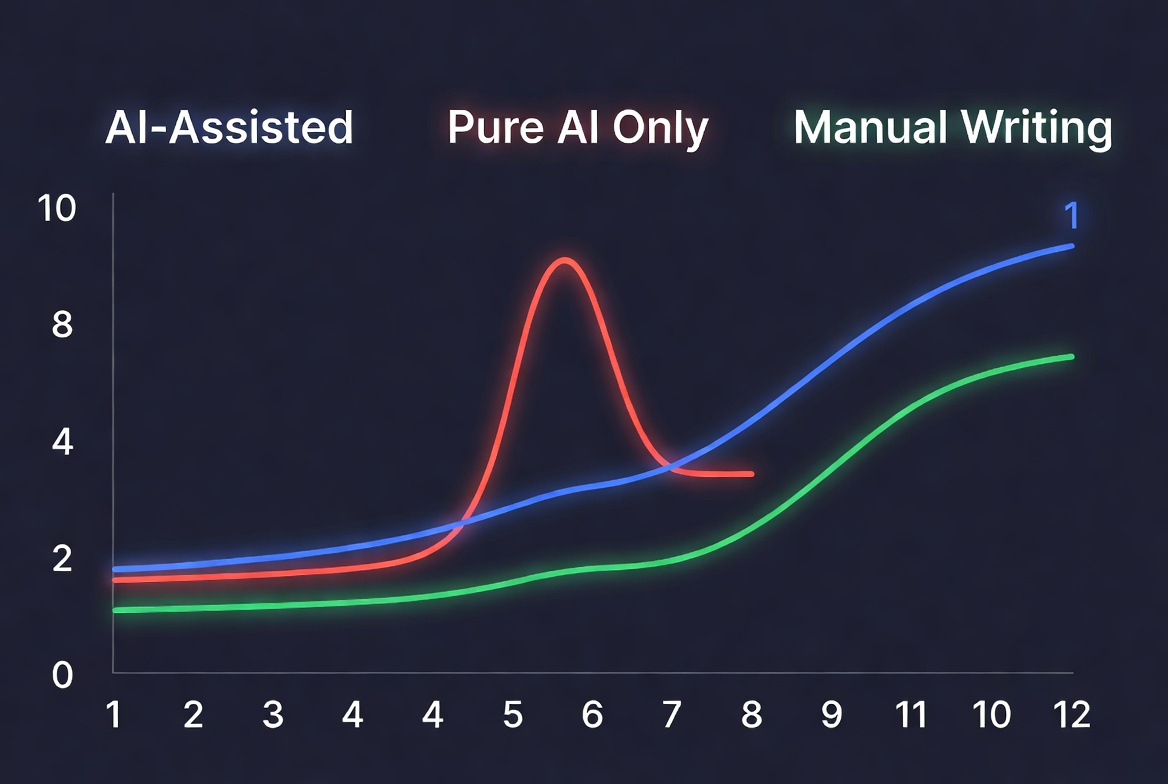
The most rigorous AI-only study to date. Researchers bought 20 brand-new domains and published 100 fully AI-generated articles on each — 2,000 articles total, with no backlinks, no human editing, no content updates.
70.95% indexed. 80% of sites ranked for at least 100 queries. Impressions looked promising for zero-authority domains.
Traffic accelerated. Total impressions climbed past 526,000. Clicks more than tripled (244 → 782). No backlinks needed to get here.
Only 3% of pages remained in the top 100 — down from 28% in month one. The content collapsed without human signals.
Rankings did not recover. Visibility stayed extremely low for the remaining 11 months with no human editing applied.
Brief recovery. Pages in top 100 rose from 3% back to 20% — still below the month-one peak. Did not sustain.
Fast to index. Fast to rank initially. Fast to collapse at month 3. Without human editing, pure AI content does not sustain rankings beyond the 3-month mark on new domains.
Case Study 2: AI-Assisted Content on an Established Domain
SE Ranking Blog Experiment, Jun 2024–Jul 2025
The same team ran 6 AI-assisted articles on their existing high-authority blog — AI-drafted, then human-edited and fact-checked.
Over 13 Months
From Google Search
in Organic Top 10
AI Overview Sources
Human-edited AI content on an established domain performs extremely well — sustained top-10 rankings and AI Overview citations. The human layer is the difference-maker.
Case Study 3: Semrush — 42,000 Blog Pages (Nov 2025)
Semrush analysed top-10 Google results across 20,000 keywords and classified each result by content type. The headline finding:
“57% of AI-generated content appeared in the top 10 — compared to 58% of human-written content. A statistically negligible gap when quality is controlled.”
— Semrush Blog Page Analysis, November 2025
04Manual Content Ranking Timeline — Real Case Study Data
When comparing AI content vs manual content ranking time, manual (human-only) content follows a more predictable curve — but the data shows it is not necessarily faster or guaranteed to rank. It simply ages better and attracts more backlinks naturally.
The General Benchmark: 3–6 Months to Page 1
Across polls of 3,680 SEO professionals (Ahrefs, 2025), the most commonly reported timeline for SEO to show results is three to six months. That baseline applies equally to both human and AI content — content type alone is not the dominant ranking factor.
NP Digital: Human Content Traffic Advantage
Neil Patel’s NP Digital research found that human-written content generated 5.44× more traffic than AI-generated content in direct comparisons. Important caveat: this compared high-quality human writing against largely unedited AI output. The gap narrows dramatically when AI content receives proper human editing and SEO optimisation.
Reboot Online: AI vs Human in the Top 3
Reboot Online’s multi-domain experiment found that pages written entirely by AI reached the top 10 in 28% of cases — but only 6% reached the top 3. Human-written pages with genuine expertise showed stronger sustained rankings, especially on competitive queries.
Ahrefs: The Age Factor Favouring Manual Content
The 2025 Ahrefs study is sobering: the average #1 ranking page is now five years old. Older pages — which skew heavily toward established human-written content — carry accumulated backlinks, trust signals, user engagement data, and crawl history that no new AI article can match immediately.
Neither AI nor human content gives you an automatic shortcut around domain age and trust-building. The critical difference is in how you use your limited publishing time and budget on the path to authority.
05Side-by-Side: AI Content vs Manual Content Ranking Time
This is the link magnet on AI content vs manual content ranking time. No other resource compares all three approaches across this many dimensions with real 2025–2026 data behind every row. Bookmark it, share it, cite it.
| Factor | 🤖 AI-Assisted (Human-Edited) |
⚠️ Pure AI (No Edits) |
✍️ Manual (Human-Only) |
|---|---|---|---|
| Avg. time to first index | 1–4 weeks | 1–5 weeks (71% in ~36 days) | 2–6 weeks |
| Avg. time to page 1 | 2–5 months | 1–3 months (then drops) | 3–6 months |
| Ranking sustainability | High — ages well | Low — collapses ~month 3 | High — ages very well |
| Top-10 appearance rate | 57% (Semrush 2025) | 28% briefly / 3% sustained | 58% (Semrush 2025) |
| Typical word count (ranking) | 1,800–2,500 | 1,000–2,000 (often thin) | 1,500–3,000+ |
| Update frequency needed | Every 6–9 months | Every 1–3 months | Every 6–12 months |
| Cost per article | $15–$80 | $5–$20 | $80–$400+ |
| Google penalty risk | Low — if quality met | Medium–High (scaled content abuse) | Very low |
| Backlink attraction | Medium | Low (25% fewer vs human) | High |
| E-E-A-T signals | Medium — needs human layer | Low | High |
| Best for | New bloggers: volume + quality | Testing ideas only | Authority sites, YMYL topics |
Sources: Semrush (2025), SE Ranking/Search Engine Land (2025), Ahrefs (2025), Reboot Online (2024–2025), Writesonic (2025), NP Digital (2024)
06What Actually Affects Ranking Speed More Than Content Type
Here is the uncomfortable truth about AI content vs manual content ranking time: whether your article was written by Claude, ChatGPT, or a seasoned human writer matters far less to Google than most bloggers assume. Six factors have a far greater impact on how fast — and how sustainably — content ranks.
1. Keyword Difficulty
For high-volume keywords (10K+ monthly searches), only 0.3% of pages ranked in the top 10 within a year (Ahrefs 2025). Low-competition long-tail keywords are your only realistic target in year one — regardless of content type.
2. Domain Authority and Age
New sites rank slower regardless of content quality. A 2024 internal Google API leak referenced a “hostAge” factor that suppresses new domains. The sandbox effect typically lasts 2–3 months for low-competition niches.
3. Backlink Profile
More than half of domains with zero backlinks never reach page one (Positional 2025). Pure AI content attracts 25% fewer backlinks than human-authored content — a major long-term disadvantage. See our backlink cost guide for budget planning.
4. Content Quality and E-E-A-T
Google’s January 2025 Quality Rater update instructed raters to apply the lowest rating to pages that are almost entirely AI-generated with no original value added. Edited AI content ranks 18% higher on average than unedited output.
5. Internal Linking Structure
Strategic internal linking passes authority throughout your site and signals topical depth. Bloggers who build tight topic clusters rank faster than those publishing scattered articles — this applies equally to AI and manual content.
6. Publishing Quality Over Volume
One exceptional article per month beats four mediocre ones every week (Shopify 2026). Sites that mass-published AI content in 2023–2024 largely collapsed after Google’s March 2024 core update removed 40% of low-quality unoriginal content.
From Google Search Central:
“Using automation — including AI — to generate content with the primary purpose of manipulating ranking in search results is a violation of our spam policies. However, not all use of automation, including AI generation, is spam. Appropriate use of AI or automation is not against our guidelines.”
From their December 2025 Generative AI Guidance:
“Generative AI can be particularly useful when researching a topic, and to add structure to original content. However, using generative AI tools to generate many pages without adding value for users may violate Google’s spam policy on scaled content abuse.”
07The Winning Hybrid Approach for New Bloggers in 2026
The data on AI content vs manual content ranking time points in one clear direction: neither pure AI nor pure manual content is the optimal strategy for a new blog trying to rank in 2026. The winners are using a specific hybrid model — and Writesonic’s 2025 analysis confirmed hybrid pages ranked 34% higher on average than unedited AI content.
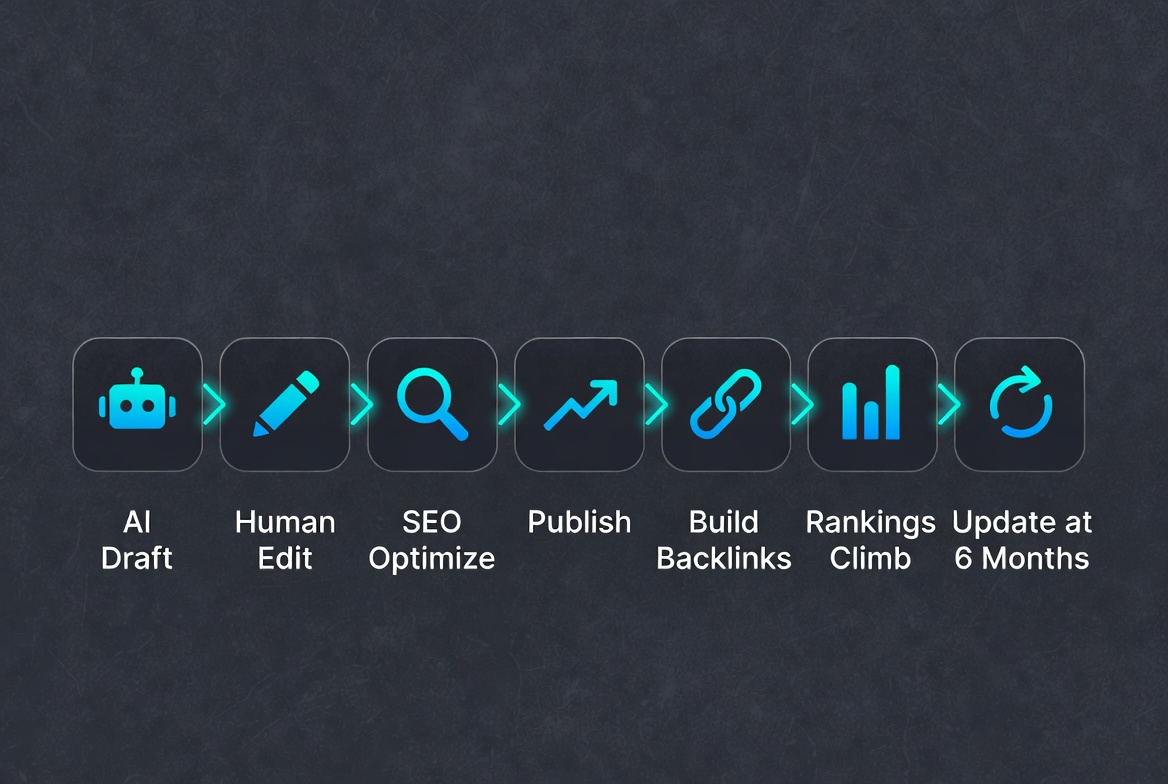
The 7-Step Hybrid Workflow That Works
- 01
Research low-difficulty keywords (KD 0–20). These are your only realistic page-1 targets in year one on a new domain. Use Ahrefs Webmaster Tools or Semrush to find long-tail keywords with clear search intent.
- 02
Use AI (Claude, ChatGPT) for the first draft. Generate structure, headings, and base content fast. AI is your research assistant and draft engine — not your editor or fact-checker.
- 03
Add your human layer — this is everything. Insert personal experience, real examples, expert quotes, and original data. This creates the E-E-A-T signals that sustain rankings beyond month 3.
- 04
Optimise with Rank Math. Keyword density 0.5–1%, meta descriptions 150–160 chars, schema markup, internal links. Do not publish until every Rank Math indicator is green.
- 05
Publish on fast, reliable hosting. Site speed is a confirmed ranking factor. For AI-driven workflows that publish frequently, your hosting infrastructure matters as much as your content quality.
- 06
Build 2–3 backlinks in your first 30 days. More than half of pages with zero backlinks never reach page one. Start with guest posts, forum mentions, and resource-page outreach.
- 07
Refresh content at 6 months. Add new data, update stats, expand thin sections. This single step often pushes AI-assisted content from position 15 to position 5 — and resets the trust clock with Google.
08Frequently Asked Questions
⚖ Editorial Verdict
The Surprising Truth: The Gap Is Smaller Than You Think — But the Stakes Are Higher
The real story on AI content vs manual content ranking time: quality AI-assisted content ranks within the same 2–5 month window as strong manual content. Pure AI content ranks fast and drops fast. The winner in 2026 is the blogger who uses AI for speed and humans for quality — every single time.
If you are a new blogger (DA 0–30): Focus on low-difficulty keywords, use the hybrid workflow above, and publish on infrastructure that matches your ambitions. Paid backlinks will not move the needle yet — content quality and keyword targeting will.
If you are in the growth phase (DA 30–50): The hybrid approach is now your engine. Pair consistent AI-assisted publishing with strategic backlink acquisition to compound your authority. For a deeper look at backlink costs and strategy, see our Real Cost of Backlinks in 2026 guide.
- Target KD 0–20 keywords exclusively until your domain hits DR 20+
- Use AI for first drafts — always add your human experience layer before publishing
- Follow the 7-step hybrid workflow above for every article
- Get Rank Math indicators green before publishing — never skip this step
- Build at least 2–3 backlinks within 30 days of each major article
- Set a 6-month calendar reminder to refresh every article with new data
- Track impressions and clicks in Google Search Console weekly — not monthly
Bloggers using AI content workflows publish frequently — and that demands hosting infrastructure that keeps pace. ScalaHosting Managed VPS delivers the speed, uptime, and scalability that serious bloggers need, without the complexity of managing a server yourself. It is what this blog runs on.
🛠 Explore More FREE SEO & Website Tools
- 🛠 Free SEO & Website Tools — keyword tools, SEO checkers, and more at keyforriches.com
- 🔍 Ahrefs Webmaster Tools (Free) — track your rankings, DR, and backlink profile
- 📊 Google Search Console (Free) — monitor impressions, clicks, and indexation status
- ✅ Rank Math SEO Plugin (Free) — the SEO plugin used on this blog for every article
- 📈 Google’s Official AI Content Guidelines — stay compliant with the latest guidance
- → AI Tech News Roundup: Latest Tools for Bloggers — ai.keyforriches.com
- → The Real Cost of Backlinks in 2026: Claude Code vs Manual vs Paid — ai.keyforriches.com
- → ScalaHosting VPS Review: Is It Worth It for Bloggers? — ai.keyforriches.com
- → Ahrefs: How Long Does It Take to Rank in Google? (2025 Study)
- → SE Ranking: 16-Month AI Content Experiment (Full Study)